 The nation pays tribute to the founder of Pakistan, Quaid-i-Azam Mohammad Ali Jinnah, on his 132nd birth anniversary on Thursday.The day will be observed with seminars and special ceremonies at which services and contributions of the Quaid will be remembered.Television and radio stations will air programmes highlighting the life, thoughts and achievement of the great leader.National flag will be hoisted on government and private buildings across the country.National leaders have issued statements and messages for the occasion.President Asif Ali Zardari said in a message that it was important to recognise that social development guaranteed national security and stability.“We need to appreciate that democracy, development and social and human welfare are no less guarantors of peace and security,” the president said.He said militants and their “godfathers wanted to make Pakistan a security-driven state instead of a welfare-oriented state, because it suits their political agenda”.Stressing the need for defeating the elements preaching hatred, the president said that the Quaid’s birthday was an opportunity for the people to rededicate their lives to the father of the nation’s ideals.“The Quaid-i-Azam believed in the power of ballot and not bullet, and stood for constitutionalism, rule of law, respect for human rights, tolerance, pluralism and honouring the mandate of the people.”President Zardari urged the people to reclaim the Quaid’s Pakistan and unleash their creative powers through freedom and an end to terrorism and violence.“It is a day … to pause and ponder as to what steps we must take to restore the ideals and principles for which the Quaid created this homeland of ours.”President Zardari said it was unfortunate that the country suffered extremism, poverty, unemployment and inflation because of dictatorships and unrepresentative rulers.He said it was sad that militants and their supporters were threatening the Quaid’s ideals and depriving people of basic necessities of life.
Thursday, December 25, 2008
Nation pays tribute to Quaid today
The nation pays tribute to the founder of Pakistan, Quaid-i-Azam Mohammad Ali Jinnah, on his 132nd birth anniversary on Thursday.The day will be observed with seminars and special ceremonies at which services and contributions of the Quaid will be remembered.Television and radio stations will air programmes highlighting the life, thoughts and achievement of the great leader.National flag will be hoisted on government and private buildings across the country.National leaders have issued statements and messages for the occasion.President Asif Ali Zardari said in a message that it was important to recognise that social development guaranteed national security and stability.“We need to appreciate that democracy, development and social and human welfare are no less guarantors of peace and security,” the president said.He said militants and their “godfathers wanted to make Pakistan a security-driven state instead of a welfare-oriented state, because it suits their political agenda”.Stressing the need for defeating the elements preaching hatred, the president said that the Quaid’s birthday was an opportunity for the people to rededicate their lives to the father of the nation’s ideals.“The Quaid-i-Azam believed in the power of ballot and not bullet, and stood for constitutionalism, rule of law, respect for human rights, tolerance, pluralism and honouring the mandate of the people.”President Zardari urged the people to reclaim the Quaid’s Pakistan and unleash their creative powers through freedom and an end to terrorism and violence.“It is a day … to pause and ponder as to what steps we must take to restore the ideals and principles for which the Quaid created this homeland of ours.”President Zardari said it was unfortunate that the country suffered extremism, poverty, unemployment and inflation because of dictatorships and unrepresentative rulers.He said it was sad that militants and their supporters were threatening the Quaid’s ideals and depriving people of basic necessities of life.


Monday, December 22, 2008

NEW YORK - Chief of Army Staff General Ashfaq Parvez Kayani is ranked among the “50 Most Powerful People of the World” selected by Newsweek, a leading American weekly magazine. The list, carried in the magazine’s January issue, is led by President-elect Barack Obama, whose legacy, it said, will be decided by actions he takes over the next four years.Congress President Sonia Gandhi and Bollywood superstar Shahrukh Khan also make the list. Among others, it includes Saudi King Abdullah bin Abdulaziz Al-Saud, United Arab Emirates President Khalifa bin Zayed Al Nahyan, Iran’s Supreme leader Ali Khamenei and Hezbollah leader Hassan Nasrallah.Gen Kayani is placed at 20 on the list. In theory, Newsweek says, he answers to President Asif Ali Zardari. But Gen Kayani and his troops remain the dominant power in what could be the “most dangerous country in the world”. “He’s responsible for Pakistan’s nukes; for the battle against Al-Qaeda and its tribal allies along the Afghan border; and for managing tensions with neighbour India,” Newsweek stresses, noting that so far, the Pakistan Army has kept itself out of politics and seems focused on the battle against extremists. “In the wake of the November terrorist attacks in Mumbai, Kayani stood firm on Pakistan’s sovereignty while also taking measures against the alleged sponsors of the outrage,” it says.“Kayani insists he’s a committed democrat, but he nevertheless argues that military interventions (there have been four since independence 61 years ago) are sometimes necessary to maintain Pakistan’s stability. He likens coups to temporary bypasses that are created when a bridge collapses on democracy’s highway. After the bridge is repaired, he says, then there’s no longer any need for the detour,” it added.Obama, who tops the list, is followed by Chinese President Hu Jintao, French President Nicolas Sarkozy, British Prime Minister Gordon Brown, German Chancellor Angela Markel and powerful Russian Prime Minister Vladimir Putin.A surprise inclusion in list, which the magazine admits is subjective, is Osama bin Laden, whom the Newsweek describes as “global terrorist”. North Korean leader also Jim Jong II finds place in the list. Placing Sonia Gandhi at 17th spot, the magazine says though Indian political scene is riven by factions, Congress remains the strongest national force and rules unchallenged. “In the world’s largest democracy, she is the queen.”The magazine describes Shahrukh Khan, who occupies 41st spot, as the King of Bollywood.“It’s not just that his romantic flicks make gazillions - it’s where those gazillions come from. Khan is huge in the Muslim world, even in Pakistan and Afghanistan. (The movies thrive on the black market.) Their main appeal is certainly the song-and-dance numbers, but Khan (a Muslim married to a Hindu) makes devoutly secular films where love trounces bigotry,” it says, adding that Sonia Gandhi gives Khan’s DVDs to visitors, especially Muslim ones. “Here’s hoping tolerance will leap from reel life to real life.”For Osama bin Laden, who finds 42nd spot, the magazine says the manhunt may not have been successful, but it has driven him far underground. Once a glutton for publicity, he hasn’t shot a new video since September 2007, and no audio message from him has been heard since May 2008, it adds and quotes knowledgeable Taliban sources as saying “the sheik” (as acolytes call him) rarely has contact with even his top lieutenants, who are steadily being eliminated: in 2008, at least eight of the 20 most wanted Al-Qaeda operatives died in Predator attacks along the Afghan border. “The underlings who have replaced them don’t match their brains or planning skills, Taliban sources say. But as the Mumbai attacks showed, Osama’s ideology continues to inflict monstrous harm,” it points out. Awarding Chinese President Hu second place, Newsweek says he is a guy “you wouldn’t think twice about - cautious, colourless and corporate and in the past, he has lost spotlight to other world leaders with bigger egos and sharper elbows. “But to underestimate Hu Jintao would be a monumental error. His position as China’s President makes him CEO of a financial juggernaut that’s projected to post USD 280 billion trade surplus this year. While the rest of the world plunges deeper into recession, Hu the Humble is emerging as the one who is holding the lifeline.” The economic crisis and market meltdown has got “Economic Triumvirate” place among the top ten. They are central bankers: Ben Bernanke of the US Federal Reserve; Jean-Claude Trichet of the European Central Bank (ECB); Masaaki Shirakawa of the Bank of Japan; and, to a lesser extent, counterparts in China, India, Brazil, Mexico and elsewhere.“They are enormously powerful, and in 2009 they may determine whether the global economy avoids calamity, the magazine notes. Not since the early 1980s, when high inflation plagued many advanced economies, or perhaps the 1930s, has their role been so crucial as global economic growth is slowing to a standstill,” Newsweek says. “Economists at Deutsche Bank forecast that the world economy will expand a meagre 0.2 per cent in 2009 - the worst year since at least 1950. In 2007, growth was almost 5pc. Without stronger growth, the slump might feed on itself and fuel economic nationalism,” it warns.Giving reasons for placing Kim on the list, Newsweek notes that he is in bad shape after suffering a stroke but still presides over a handful of nuclear weapons, an arsenal of long-range missiles and a million-man army.A weakened leader could in fact feel compelled to prove his toughness by threatening outside world. An in recent weeks Pyongyang has halted its rapprochement with South Korea and “torpedoed” talks aimed at getting it to give up its nuclear weapons. “Whether strong or weak, he’s still dangerous,” it observes.Others on the list include the Dalai Lama, Bill and Hillary Clinton, Gen David Petraeus, Iraqi leader Nuri al-Maliki, US House speaker Nancy Pelosi, New York Mayor Michael Bloomberg, Pope Benedict XVI, Media Mogul Rupert Murdoch and popular show host Oprah Winfrey.
Saturday, December 20, 2008
Conceding space to bigotry
ON November 19, the Council of Islamic Ideology of Pakistan issued recommendations giving women the right to seek divorce in written form and binding the parties to settle the matter within 90 days. Exceeding this deadline the divorce would automatically be considered valid.When the CII made the recommendations public there began much commotion in the circles of the religious parties and factions. The announcement seems to have got on their nerves. The religious parties found a new ground to mislead the public in the name of religion. They began to raise hue and cry by declaring that the recommendations were not in conformity with the spirit of the Quran and Sunnah.Two such parties, which are most vocal, started a campaign against the recommendations by challenging the very validity of the Islamic Ideology Council. They contended that the members of the Council were not reliable since they had been selected by ex-president Gen Musharraf. The irony is that they came to realise this fact after getting favours from Musharraf in return for their covert support, enabling him to rule the country for eight years.Coming from a region where culture is equated with religion, these elements wailed until the government publicly dissociated itself from the Council’s recommendations. The religious groups thus succeeded in winning their case by pressuring the government. Despite bringing the recommendations to parliament for debate, the government succumbed to these bigots. In democratic countries, parliament has the sole authority to discuss and enact legislation but in Pakistan it is often used as a way out to undermine a lawful demand. Yet the refrain remains that parliament is supreme.The political parties pursuing reactionary politics are known for their peculiar mindset, hypocrisies and manipulations. They believe only in their own version of Islam and oppose any other interpretation. But the role of the mainstream political parties has also been equally annoying. We have now a party at the helm of affairs of the state which claims to be secular and liberal. It is not the first time that this party has become fearful of bigots. In 1974, too, under the charismatic leadership of Z. A. Bhutto, the People’s Party had yielded to an exclusionary demand of the reactionary religious elements which in fact sowed the seeds of what we are harvesting now. If the government had overcome the fear of these elements at that time, the religious militancy would not have flourished in the country.In the media, especially electronic, we hear specialists speaking at the talk shows on affairs in a manner which can only mislead the viewers. Very often, one finds the same political personalities appearing on several channels. They just bicker and often squabble as well. The media, too, seems scared of these reactionary politicians. There are exceptions, indeed. Some channels try, of course, to present different perspectives on religious matters as well but that does not often lead to a healthy debate and discourage these elements from hammering out their fixed views again and again in an arrogant manner. As such, the talk shows often fail to provide a positive view of certain related issues.One also hears views which implicitly encourage militancy. In the dailies, especially in Urdu newspapers, one can read statements which indirectly favour the militants/terrorists. Those who give such statements presume that the militancy has wide support among the general public. For instance, the NWFP JI Amir, Sirajul Haq, two months, back stated that the NGOs were spreading adultery (fahaashi). Similarly, in a recent annual party congregation (ijtima), Qazi Hussan Ahmad said that this gathering would help accelerate the current jihad for Sharia.In an Urdu newspaper two weeks back, Maulana Fazlur Rehman contended that although the people (militants) defend their creed (religion) but everywhere they are called terrorists. It is worth noting what such statements suggest and if at all how much these leaders feel about the plight of the people. The religious leaders adopt such a stance because they are losing their stakes owing to the war on terror. No politico-religious leader has ever publicly condemned the killing of innocent people by suicide bombing and target killing.Even Nawaz Sharif, currently most popular leader, is also reluctant to denounce the militancy. Similar is the case of Imran Khan. He seems to have no clear party position on this matter at all. It is amazing that both Nawaz and Imran are silent on the killing of people by the militants. They only prefer to condemn the US attacks in Fata areas (and now on settled areas) but to claim that the killing of people inside Pakistan is simply a reaction to the US-led strikes within the territory of Pakistan is a jaundiced view. For instance, what have the CDs stores, shops selling items of daily use for ladies and girls' schools to do with the US strikes in Fata or elsewhere? Do these shopkeepers send the drones?It is understandable that common citizens cannot resist or counter-attack terrorists for they can easily be wiped out. They do not have the privilege of tight security nor any support from the government. Their fear is understandable. Yet those who dare speak against the scourge of militancy are dubbed as US agents by the pro-militancy 'intellectuals'.It is a pity that the government led by a party whose leader, Benazir Bhutto sacrificed her life but did not give in to bigotry, is so fearful that it publicly disowns the advice of a constitutional institution which has the sole objective to guide the state on law making in accordance with Islamic teachings.
Wednesday, December 3, 2008
The Companions of the Prophet (saws)
Abu Dharr al-Ghifari:
One of the earliest Muslims, Abu Dharr was the first person to greet the Prophet (saws) with the greeting of Islam: "As-salaamu Alayka Yaa Rasulullah, (Peace be on you, O Messenger of God)". After that, the greeting spread and came into general use.
Umayr ibn Sad al-Ansari:
A destitute boy from Madinah who became a Muslim at the age of ten. Later when appointed by Caliph Umar as Governor of the town of Hims in Syria, he was renowned for his frugal lifestyle and just rule: Islam will remain strong so long as the Sultan or central authority is strong. The strength of the Sultan neither comes from flogging with the whip, nor killing with the sword but from ruling with justice and holding fast to truth.
Abbad ibn Bishr:
A courageous warrior whose devotion to the Qur'an was a sign of his intense devotion to and love for God, His Prophet (saws) and His religion.
Barakah:
O Barakah, I shall depart from this world shortly. I commend my son Muhammad to your care. He lost his father while he was in my abdomen. Here he is now, losing his mother under his very eyes. Be a mother to him, Barakah. And don't ever leave him'.The touching story of the cradle to grave devotion of the Ethiopian slave girl who reared Prophet Mohammed (saws) after the death of his parents and was a selfless and courageous early Muslim.
Khadijah (ra):
Successful businesswoman, wife of Prophet Mohammed (saws) and the first person to convert to Islam.
Abdullah ibn Hudhafah as-Sahmi:
A companion who met two great world leaders of the day. First he was Prophet Mohammed's (saws)emissary to Khusraw Parvez, the King of Persia. Years later during the caliphate of Umar ibn al-Khattab, Abdullah ibn Hudhafah as-Sahmi was captured in battle against the Byzantine empire. Neither inducements nor torture at the hands of the Emperor Heraclius could persuade him to renounce Islam.
Abdur-Rahman Ibn Awl:
The eighth person to embrace Islam, he migrated twice to Abyssinia. Abdur-Rahman distinguished himself in both the battles of Badr and Uhud, suffering more than twenty wounds at the latter. Starting with nothing, he went on to enjoy tremendous success as a merchant, becoming the richest of the Companions. From his great wealth, Abdur-Rahman financed the Muslim armies, contributed to the the upkeep of the family of Mohammed (saws) after the prophet's death and was universally renowned for his fabulous generosity.
Utbah ibn Ghazwan:
Great Muslim military commander under Caliph Umar. Founder of the city of Basra, he continued to live in a tent so as to strengthen his faith and not be seduced by soft living.
Abu-d Dardaa:
The last man in his district of Yathrib (Madinah) to embrace Islam, he set about making up for lost time. He later declined Caliph Umar's offer to become Governor of Damascus, but instead agreed to go there to teach the people the Book of their Lord and the Sunnah of the Prophet (saws) and pray with them.
Fatima bint Muhammad:
The moving story of the beloved fifth child of Mohammed (saws) and Khadija (ra). Fatima endured a childhood of suffering because of the persecution of her father and his followers. She was so devoted to the Prophet and took such good care of him after Khadija's death that she became known as Umm Abi-ha, the mother of her father. It was only through Fatima's children that the Prophet's lineage has survived.
Rumaysa bint Milhan (Umm Sulaym):
mm Sulaym was a model Muslim, a model wife and mother. Known for her excellent character, the power of her intellect and her independent attitude of mind, she was one of the first women in Madinah to embrace Islam. After being widowed, the only dowry she demanded of her wealthy second husband was that he accept Islam. Noted for her great courage and bravery, Umm Sulaym accompanied the Muslim armies, caring for the wounded and attempted to defend Prophet Mohammed (saws) with her dagger at Uhud when the tide of battle turned against the Muslims.
Ubayy ibn Kab:One of the first citizens of Madinah to embrace Islam, he served as scribe to Prophet Mohammed (saws), was one of the first to commit the Qur'an to writing, and belonged to the group of about two dozen who knew the entire Qur'an by heart when the Prophet (saws) died. Regarded as a conscience to the Muslims, he later served as advisor to Caliphs Abu Bakr` and Umar and was greatly respected for his honest and frank assessments.
Aisha bint Abi Bakr:Daughter of Abu Bakr and beloved wife of Prophet Mohammed`(saws), in the fifty years following his death, she became a great teacher of Islam and preserved and transmitted over two thousand hadeeth.
Abu Musa al-Ashari:Yemeni missionary, military commander, judge and Governor of Basra, renowned for his integrity, who represented Imam Ali in the dispute with the usurper Muawiyah.
Umayr ibn Wahb:He went to Medina to assassinate Mohammed (saws).He returned to Mecca a Muslim missionary.
Umm Salamah:She gave up her life of wealth and privilege for Islam, became a refugee, endured the kidnap of her son and the fatal wounding of her first husband, turned down marriage proposals from both Abu Bakr and Umar before finally accepting that of Mohammed (saws) and becoming Umm al-Mumineen, mother of the believers. An eventful life!
Abdullah ibn Abbas:Young cousin of prophet Mohammed who went on to become a famed memorizer of hadeeth and great peacemaker among the Muslim factions.
Habib ibn Zayd al-Ansari:The young son of early converts, he suffered suffered a horrible death rather than renounce his faith.
One of the earliest Muslims, Abu Dharr was the first person to greet the Prophet (saws) with the greeting of Islam: "As-salaamu Alayka Yaa Rasulullah, (Peace be on you, O Messenger of God)". After that, the greeting spread and came into general use.
Umayr ibn Sad al-Ansari:
A destitute boy from Madinah who became a Muslim at the age of ten. Later when appointed by Caliph Umar as Governor of the town of Hims in Syria, he was renowned for his frugal lifestyle and just rule: Islam will remain strong so long as the Sultan or central authority is strong. The strength of the Sultan neither comes from flogging with the whip, nor killing with the sword but from ruling with justice and holding fast to truth.
Abbad ibn Bishr:
A courageous warrior whose devotion to the Qur'an was a sign of his intense devotion to and love for God, His Prophet (saws) and His religion.
Barakah:
O Barakah, I shall depart from this world shortly. I commend my son Muhammad to your care. He lost his father while he was in my abdomen. Here he is now, losing his mother under his very eyes. Be a mother to him, Barakah. And don't ever leave him'.The touching story of the cradle to grave devotion of the Ethiopian slave girl who reared Prophet Mohammed (saws) after the death of his parents and was a selfless and courageous early Muslim.
Khadijah (ra):
Successful businesswoman, wife of Prophet Mohammed (saws) and the first person to convert to Islam.
Abdullah ibn Hudhafah as-Sahmi:
A companion who met two great world leaders of the day. First he was Prophet Mohammed's (saws)emissary to Khusraw Parvez, the King of Persia. Years later during the caliphate of Umar ibn al-Khattab, Abdullah ibn Hudhafah as-Sahmi was captured in battle against the Byzantine empire. Neither inducements nor torture at the hands of the Emperor Heraclius could persuade him to renounce Islam.
Abdur-Rahman Ibn Awl:
The eighth person to embrace Islam, he migrated twice to Abyssinia. Abdur-Rahman distinguished himself in both the battles of Badr and Uhud, suffering more than twenty wounds at the latter. Starting with nothing, he went on to enjoy tremendous success as a merchant, becoming the richest of the Companions. From his great wealth, Abdur-Rahman financed the Muslim armies, contributed to the the upkeep of the family of Mohammed (saws) after the prophet's death and was universally renowned for his fabulous generosity.
Utbah ibn Ghazwan:
Great Muslim military commander under Caliph Umar. Founder of the city of Basra, he continued to live in a tent so as to strengthen his faith and not be seduced by soft living.
Abu-d Dardaa:
The last man in his district of Yathrib (Madinah) to embrace Islam, he set about making up for lost time. He later declined Caliph Umar's offer to become Governor of Damascus, but instead agreed to go there to teach the people the Book of their Lord and the Sunnah of the Prophet (saws) and pray with them.
Fatima bint Muhammad:
The moving story of the beloved fifth child of Mohammed (saws) and Khadija (ra). Fatima endured a childhood of suffering because of the persecution of her father and his followers. She was so devoted to the Prophet and took such good care of him after Khadija's death that she became known as Umm Abi-ha, the mother of her father. It was only through Fatima's children that the Prophet's lineage has survived.
Rumaysa bint Milhan (Umm Sulaym):
mm Sulaym was a model Muslim, a model wife and mother. Known for her excellent character, the power of her intellect and her independent attitude of mind, she was one of the first women in Madinah to embrace Islam. After being widowed, the only dowry she demanded of her wealthy second husband was that he accept Islam. Noted for her great courage and bravery, Umm Sulaym accompanied the Muslim armies, caring for the wounded and attempted to defend Prophet Mohammed (saws) with her dagger at Uhud when the tide of battle turned against the Muslims.
Jafar ibn Abi Talib:Cousin of Mohammed (saws) and brother of Ali, Jafar was renowned for his care for the poor and was one of the first to embrace Islam. Facing persecution in Makkah, Jafar led the group of Muslims who migrated to Abyssinia (now Ethiopia) and successfully represented them before the king when Quraysh emissaries sought to have them extradited. Jafar fell in battle against Byzantine forces after his return to Arabia.
Abu Hurayrah:All Muslims throughout the ages owe a tremendous debt of gratitude to Abu Hurayah. Blessed with a formidable memory, he was the single greatest of all the transmitters of the hadith of the Prophet (saws). Once destitute, in later life Abu Hurayrah rose to become governor of Madinah then Bahrain.
Adiyy ibn Hatim:This Christian Arab king, for twenty years an inveterate enemy of Islam, went unprotected to Madinah to meet Mohammed (saws) after the Prophet (saws) treated his captured sister kindly and released her.
Abdullah ibn Umm Maktum:A blind, young cousin of Khadijah (raa), Abdullah ibn Umm Maktum was one of the earliest Muslims. He was left in charge of Madinah on more than ten occasions during Prophet Mohammed's (saws) absences and later, despite his disability, went into battle as the standard bearer of the Muslims. "Place me between two rows and give me the standard. I will carry it for you and protect it, for I am blind and cannot run away."Ubayy ibn Kab:One of the first citizens of Madinah to embrace Islam, he served as scribe to Prophet Mohammed (saws), was one of the first to commit the Qur'an to writing, and belonged to the group of about two dozen who knew the entire Qur'an by heart when the Prophet (saws) died. Regarded as a conscience to the Muslims, he later served as advisor to Caliphs Abu Bakr` and Umar and was greatly respected for his honest and frank assessments.
Aisha bint Abi Bakr:Daughter of Abu Bakr and beloved wife of Prophet Mohammed`(saws), in the fifty years following his death, she became a great teacher of Islam and preserved and transmitted over two thousand hadeeth.
Abu Musa al-Ashari:Yemeni missionary, military commander, judge and Governor of Basra, renowned for his integrity, who represented Imam Ali in the dispute with the usurper Muawiyah.
Umayr ibn Wahb:He went to Medina to assassinate Mohammed (saws).He returned to Mecca a Muslim missionary.
Umm Salamah:She gave up her life of wealth and privilege for Islam, became a refugee, endured the kidnap of her son and the fatal wounding of her first husband, turned down marriage proposals from both Abu Bakr and Umar before finally accepting that of Mohammed (saws) and becoming Umm al-Mumineen, mother of the believers. An eventful life!
Abdullah ibn Abbas:Young cousin of prophet Mohammed who went on to become a famed memorizer of hadeeth and great peacemaker among the Muslim factions.
Habib ibn Zayd al-Ansari:The young son of early converts, he suffered suffered a horrible death rather than renounce his faith.
Monday, December 1, 2008
Why Two Women Witnesses?
A question that repeatedly arises is that concerning the 'position of women in Islâm'. Muslim scholars have been able with great success - despite the onslaught of distortion and misrepresentation - to demonstrate the true position of Muslim women; especially of women's liberation in the advent of Islâm. The Islamic ruling on issues such as inheritance, the right to earn, the right to own property etc. have reinforced this position and have been prescribed by Allâh - the One True God - long before western nations even thought of such concepts!
The issue of two women witnesses in place of one man is the concern of the present treatise. As will become clear to the sincere and objective reader, the intellectual status of a Muslim woman is neither marred nor degraded by the commandment that if two Muslim male witnesses are not available then one Muslim male and two Muslim females should be invited to witness. Rather, this injunction is in perfect harmony with the nature and psychology of the woman as will become evident through quotations from psychologists, psychiatrists and medical research.
The issue of two women witnesses in place of one man is the concern of the present treatise. As will become clear to the sincere and objective reader, the intellectual status of a Muslim woman is neither marred nor degraded by the commandment that if two Muslim male witnesses are not available then one Muslim male and two Muslim females should be invited to witness. Rather, this injunction is in perfect harmony with the nature and psychology of the woman as will become evident through quotations from psychologists, psychiatrists and medical research.
The passage of the Qur'ân (Baqarah 2:282) in which the above-mentioned requirement is made has usury, capital and debtor difficulties as its theme. Allâh grants guidelines in matters relating to monetary obligations. Then business transactions are dealt with. In this section, the requirement to commit all transactions into writing is stated most emphatically (Reduce them to writing...). The section after this describes the responsibility of the scribe, or in modern parlance, the person responsible for drawing up the agreement. The following section describes the responsibility and the obligation of the person incurring the liability. The section after this explains how if the party that is liable cannot effectively draw up the contract - out of being deficient or weak mentally, or being unable to dictate - then his or her guardian should help draw out the contract and choose two suitable witnesses to observe. It must be understood that this situation arises if it is not possible for the liable party to draw out the contract by him/herself. The condition to put things into writing is still supreme. The next section then explains that two men should be called to witness and if two men are not available (And if there are not two men...) then a man and two women. The legislation then continues and reminds most emphatically that one should not be complacent about putting ALL agreements into writing - no matter whether these agreements are major or minor as this is more JUST in the sight of Allâh and more reliable as evidence. The passage of the Qur'ân further explains that for practical reasons it may not always be possible to commit on-the-spot agreements into writing. In this case, it is also recommended that it be witnessed. The section which follows then lays down the guidelines which should be followed in the event that no witnesses are present.
The purpose in giving the above outline is to draw attention to the fact the question of women witnesses relates, in this instance, to commercial agreements and is not a statement on their status.
Let's look at the section under investigation in more detail. Allâh said:
And get two witnesses of your own men, and if there are not two men then a man and two women such as you choose for witnesses - so that if one of them errs, the other can remind her... [Baqarah 2:182]
A number of questions (as well as eyebrows!) are raised when this section of the passage is read. The questions often posed include:
Do women have weaker memories than men?Why should two women be needed in the place of one man?Are women inferior to men?
One must remember that Prophet Muhammad sallâllahu 'alayhi wa sallam was neither a physiologist, a psychiatrist and nor a surgeon. He was an illiterate and could neither read nor write. He passed on the revelation exactly as he received it. Allâh, the Creator, with His infinite wisdom gave the directives best suited to humankind. He is the Creator, therefore, He knows man better than a man himself.
In this scientific age we can explore the significance of this legislation. A great deal has been discovered since the early days of Islâm. And each day of advancement brings about a better understanding of the the last and final revelation from the Creator, Allâh to the creation, humankind. As women, we are aware of the cyclical psychological strains that a woman has to encounter every month. The symptoms during early pregnancy, ante-natal and post-natal depressions, the phenomenon of menopause, the physiological and psychological problems due to infertility and last but not least the psychological problems faced after miscarriage.
It is under these situations that women can experience extraordinary psychological strains giving rise to depression, lack of concentration, slow-mindedness and short term memory loss. Let us examine these episodes in a bit more detail and with medical references from the scientific world. PMT is an umbrella term for more than 140 different symptoms and there is a lot of evidence that it causes a lot of unhappiness in many women, and consequently, to their families.
Psychiatry in Practice, April 1983 issue states:
"Forty percent of women suffer from pre-menstrual syndrome in some form and one in if our women have their lives severely disrupted by it. Dr Jill Williams, general practitioner from Bury, gives guidelines on how to recognise patients at risk and suggests a suitable treatment." [Psychiatry in Practice, April 1993, p.14]
In the same issue, George Beaumont reporting on the workshop held at the Royal College of Obstetricians and Gynaecologists in London on pre-menstrual syndrome, says:
"Some authorities would argue that 80 percent of women have some degree of breast and abdominal discomfort which is pre-menstrual but that only about 10 percent complain to their doctors - and then only because of severe tenderness of the breasts and mental depression... Other authorities have suggested that pre-menstrual syndrome is a new problem, regular ovulation for 20 years or more being a phenomenon caused by 'civilisation', 'medical progress', and an altered concept of the role of women." [Psychiatry in Practice, April 1993, p.18]
In its examination of the occurrence of physical and psychological change during the period just prior to the onset of menstruation we read in Psychological Medicine:
"Many studies have reported an increased likelihood of various negative affects during the pre-menstrual period. In this affective category are many emotional designations including irritability, depression, tension, anxiety, sadness, insecurity, lethargy, loneliness, tearfulness, fatigue, restlessness and changes of mood. In the majority of studies, investigators have found it difficult to distinguish between various negative affects, and only a few have allowed themselves to be excessively concerned with the differences which might or might not exist between affective symptoms." [Psychological Medicine, Monograph Supplement 4, 1983, Cambridge University Press, p.6]
In the same article dealing with pre-menstrual behavioural changes we read:
"A significant relationship between the pre-menstrual phase of the cycle and a variety of specific and defined forms of behaviour has been reported in a number of studies. For the purpose of their review, these forms of behaviour have been grouped under the headings of aggressive behaviour, illness behaviour and accidents, performance on examination and other tests and sporting performance." [Psychological Medicine, Monograph Supplement 4, 1983, Cambridge University Press, p.7]
The lengthy review portrays how female behaviour is affected in these situations. In 'The Pre-menstrual Syndrome', C. Shreeves writes:
"Reduced powers of concentration and memory are familiar aspects of the pre-menstrual syndrome and can only be remedied by treating the underlying complaint."
This does not mean, of course, that women are mentally deficient absolutely. It just means that their mental faculties can become affected at certain times in the biological cycle. Shreeves also writes:
"As many as 80 percent of women are aware of some degree of pre-menstrual changes, 40 percent are substantially disturbed by them, and between 10 and 20 percent are seriously disabled as a result of the syndrome."
Furthermore, women face the problem of ante-natal and post-natal depression, both of which cause extreme cycles of depression in some cases. Again, these recurring symptoms naturally affect the mind, giving rise to drowsiness and dopey memory.
On the subject of pregnancy in Psychiatry in Practice, October-November 1986, we learn that:
"In an experiment 'Cox' found that 16 percent of a sample of 263 pregnant women were suffering from clinically significant psychiatric problems. Eight percent had a depressive neurosis and 1.9 percent had phobic neurosis. This study showed that the proportion of pregnant women with psychiatric problems was greater than that found in the control group but the difference only tended towards significance." [Psychiatry in Practice, October-November, 1986, p.6]
Regarding the symptoms during the post-natal cycle Dr. Ruth Sagovsky writes:
"The third category of puerperal psychiatric problems is post-natal depression. It is generally agreed that between10 to 15 percent of women become clinically depressed after childbirth. These mothers experience a variety of symptoms but anxiety, especially over the baby, irritability, and excessive fatigue are common. Appetite is usually decreased and often there are considerable sleep difficulties. The mothers lose interest in the things they enjoyed prior to the baby's birth, and find that their concentration is impaired. They often feel irrational guilt, and blame themselves for being 'bad' wives and mothers. Fifty percent of these women are not identified as having a depressive illness. Unfortunately, many of them do not understand what ails them and blame their husbands, their babies or themselves until the relationships are strained to an alarming degree." [Psychiatry in Practice, May, 1987, p.18]
" ... Making the diagnosis of post-natal depression is not always easy. Quite often the depression is beginning to become a serious problem around three months postpartum when frequent contact with the health visitor is diminishing. The mother may not present with depressed mood. If she comes to the health centre presenting the baby as the patient, the true nature of the problem can be missed. When the mother is continually anxious about the baby in spite of reassurance, then the primary health care worker needs to be aware of the possibility of depression. Sometimes these mothers present with marital difficulties, and it is easy to muddle cause and effect, viewing the accompanying low mood as part of the marital problem. Sometimes, only when the husband is seen as well does it become obvious that it is a post-natal depressive illness which has led to the deterioration in the marriage." [Psychiatry in Practice, May, 1987, p.18]*
Again there is a need to study the effects of the menopause about which very little is known even to this day. This phase in a woman's life can start at any time from the mid-thirties to the mid-fifties and can last for as long as 15 years.
Writing about the pre-menopausal years, C.B. Ballinger states:
"Several of the community surveys indicate a small but significant increase in psychiatric symptoms in women during the five years prior to the cessation of menstrual periods... The most obvious clinical feature of this transitional phase of menstrual function is the alteration in menstrual pattern, the menstrual cycle becoming shorter with age, and variability in cycle length become very prominent just prior to the cessation of menstruation. Menorrhagia is a common complaint at this time, and is associated with higher than normal levels of psychiatric disturbance." [Psychiatry in Practice, November, 1987, p.26]
On the phenomenon of menopause in an article in Newsweek International, May 25th 1992, Dr. Jennifer al-Knopf, Director of the Sex and Marital Therapy Programme of North-western University writes:
" ... Women never know what their body is doing to them ... some reporting debilitating symptoms from hot flashes to night sweat, sleeplessness, irritability, mood swings, short term memory loss, migraine, headaches, urinary inconsistence and weight gain. Most such problems can be traced to the drop-off in the female hormones oestrogen and progesterone, both of which govern the ovarian cycle. But every woman starts with a different level of hormones and loses them at different rates. The unpredictability is one of the most upsetting aspects. Women never know what their body is going to do to them ... "
Then there are the psychiatric aspects of infertility and miscarriage. On the subject of infertility, Dr. Ruth Sagovsky writes:
"Depression, anger and guilt are common reactions to bereavement. In infertility there is the added pain of there being nobody to grieve for. Families and friends may contribute to the feeling of isolation by passing insensitive comments. The gynaecologist and GPs have to try to help these couples against a backdrop of considerable distress." [Psychiatry in Practice, Winter, 1989, p.16]
On the subject of miscarriage the above article continues:
"Miscarriage is rarely mentioned when considering abortion. However, miscarriage can at times have profound psychological sequelae and it is important that those women affected receive the support they need. Approximately one-fifth of all pregnancies end in spontaneous abortion and the effects are poorly recognised. If however, the miscarriage occurs in the context of infertility, the emotional reaction may be severe. The level of grief will depend on the meaning of pregnancy to the couple." [Psychiatry in Practice, Winter, 1989, p.17]
Also, the fact that women are known to be more sensitive and emotional than men must not be overlooked. It is well known, for example, that under identical circumstances women suffer much greater anxiety than men. Numerous medical references on this aspect of female behaviour can be given but to quote as a specimen, we read in 'Sex Differences in Mental Health' that:
"Surveys have found different correlates of anxiety and neuroticism in the two sexes. Women and men do not become equally upset by the same things, and being upset does not have the same effect in men as in women. Ekehammer (1974; Ekehammer, Magnusson and Ricklander, 1974) using data from 116 sixteen-year-olds, did a factor analysis on self-reported anxiety. Of the eighteen different responses indicating anxiety (sweating palms, faster heart rate, and so on) females reported experiencing twelve of them significantly more often than males. Of the anxiety-producing situations studied, females reported experiencing significantly more anxiety than males reported in fourteen of them." [Katherine Blick Hoyenga and Kermit T. Hoyenga in Sex Differences in Mental Health, p.336]
It is in light of the above findings of psychologist, psychiatrists and researchers that the saying of Allâh, the Exalted:
And get two witnesses of your own men, and if there are not two men then a man and two women such as you choose for witnesses - SO THAT IF ONE OF THEM ERRS, THE OTHER CAN REMIND HER ... [Baqarah 2:182]
can be understood. One must also bear in mind that forgetfulness can be an asset. A woman has to be put up with children presenting all kinds of emotional problems and a woman is certainly known to be more resilient than man. The aim of presenting these research findings on a number of aspects related with the theme is to indicate that a woman by her biological constitution faces such problems. It does not however make her inferior to man but it does illustrate that she is different. Viewed in this way, it can only lead one to the conclusion that Allâh knows His creation the best and has prescribed precise laws in keeping with the nature of humankind.
Allâh, the Creator is - as always - All-Knowing and man (or the disbeliever in Allâh and the final, perfected, revealed way of life, Islâm) is - as usual - either ignorant and arrogant.
* As has been mentioned above the Prophet Muhammad sallâllahu 'alayhi wa sallam was neither a psychologist nor a psychiatrist. Rather, he merely conveyed the truth that was revealed to him. It is in the context of this quotation and the one before it that the following saying of the Prophet Muhammad sallâllahu 'alayhi wa sallam can be understood: "Treat your women kindly. The woman has been created from a rib, and the most curved part of a rib is its upper region. If you try to straighten it you will break it, and if you leave it as it is, it will remain curved. So treat women kindly." And in another narration: "If you try to straighten her you will break her and breaking her means divorce." [Reported by al-Bukhârî and Muslim]. This is very important advice for the man - for him to have patience and not to try to 'reform' the behavioural pattern of the woman during these times i.e. 'to straighten her'. He will not be able to do that, as it is biological in origin. Instead, he should maintain and protect his relationship with her by showing kindness.
Monday, November 17, 2008
The Great Mughal Emperors of India
The Great Mughal Emperors of India (1526 - 1707)
Babur 1483 - 1526 - 1530 (47)
Humayun 1508 - 1530 - 1540 - 1556 (48)
Akbar 1542 - 1556 - 1605 (63)
Jahangir 1569 - 1605 - 1627 (58)
Shah Jahan 1592 - 1627 - 1658 - 1666 (74)
Aurangzeb 1618 - 1658 - 1707 (89)
Background - The Delhi Sultanate - 1211 - 1526
During the last quarter of the 1100s, Muhammad of Ghor invaded the Indo-Gangetic Plain. Qutb ud-Din, one of his generals, proclaimed himself Sultan of Delhi and established the first dynasty of the Delhi Sultanate, the Mamluk Dynasty (mamluk means "slave") in 1211. Various Moslem dynasties succeeded the Mamluks over the years 1211 to 1526. They presided over a flowering of Moslem / Hindu arts, and were powerful enough to insulate India from the rampaging Mongol hordes in the north in the 1200s, though Tamerlane did get through to sack Delhi in 1398. The Sultanate period came to an end with the arival of Babur in 1526 .....
The Mughals were a Moslem dynasty which originated in central Asia. One of the secrets of the success of the greatest of the Mughal Emperors like Akbar was their religious tolerance, and indeed their enthusiasm for embracing all the religious groups within their domains.
Babur 1483 - 1526 - 1530 (47)
The first of the Great Mughals was Babur ("The Tiger"), who invaded and conquered India in 1526. He was also a diarist, an enthusiastic hunter and lover of gardens.
He died in the Ram Bagh gardens in Agra, and his tomb lies in gardens bearing his name in Kabul, Afghanistan.
Babur was the great great great grandson of the Mongol Warlord Tamerlane.


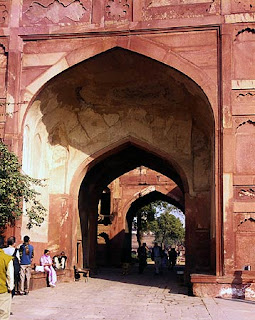 In 1638 Shah Jahan moved his capital to the Red Fort at Delhi, though it took a further 9 years for the palace complex there to be completed. He ruled from here until he became very sick in 1658, precipitating a succession battle amongst his sons which was won by Aurangzeb his third son (who became first by killing his brothers).
Poor old Shah Jahan recovered, but too late to keep his throne, and he spent the last eight years of his life locked up in the Red Fort at Agra, only being able to glimpse the Taj Mahal in the distance through the river mists. His tomb is there, however, unsymmetrically placed next to that of the his wife - the great love of his life - because his own black marble Taj was never built!
 The Red Fort at Agra (a couple of Ks from the Taj Mahal)
 The Emperor's Great Durbar Hall in the Red Fort at Agra
Babur 1483 - 1526 - 1530 (47)
Humayun 1508 - 1530 - 1540 - 1556 (48)
Akbar 1542 - 1556 - 1605 (63)
Jahangir 1569 - 1605 - 1627 (58)
Shah Jahan 1592 - 1627 - 1658 - 1666 (74)
Aurangzeb 1618 - 1658 - 1707 (89)
Background - The Delhi Sultanate - 1211 - 1526
During the last quarter of the 1100s, Muhammad of Ghor invaded the Indo-Gangetic Plain. Qutb ud-Din, one of his generals, proclaimed himself Sultan of Delhi and established the first dynasty of the Delhi Sultanate, the Mamluk Dynasty (mamluk means "slave") in 1211. Various Moslem dynasties succeeded the Mamluks over the years 1211 to 1526. They presided over a flowering of Moslem / Hindu arts, and were powerful enough to insulate India from the rampaging Mongol hordes in the north in the 1200s, though Tamerlane did get through to sack Delhi in 1398. The Sultanate period came to an end with the arival of Babur in 1526 .....
The Mughals were a Moslem dynasty which originated in central Asia. One of the secrets of the success of the greatest of the Mughal Emperors like Akbar was their religious tolerance, and indeed their enthusiasm for embracing all the religious groups within their domains.
Babur 1483 - 1526 - 1530 (47)
The first of the Great Mughals was Babur ("The Tiger"), who invaded and conquered India in 1526. He was also a diarist, an enthusiastic hunter and lover of gardens.
He died in the Ram Bagh gardens in Agra, and his tomb lies in gardens bearing his name in Kabul, Afghanistan.
Babur was the great great great grandson of the Mongol Warlord Tamerlane.
Humayun 1508 - 1530 - 1540 - 1556 (48)
Born in Kabul, Humayun was the eldest of Babur's sons, and had helped his father with the conquest of India. He ascended the throne at Agra on December 30 1530 at the age of 23, but did not have the skills to manage the immature empire, Afghan warlords, Hindu Rajput princes and his own brothers. He would have liked nothing better than to pursue his passions of mathematics and astronomy, but he had not been dealt that hand!
In 1540 he lost his empire to Afghan leader Sher Shah, but he hung in and managed to get it back 16 years later in 1556. However, only six months later he died as a result of falling down the steps of his library. Had he known all of this at the time, he might not have chosen a name which meant "the fortunate".
Humayun did, however, do one memorable thing for posterity, and that was to introduce Persian artists who blended with the locals to produce what we now know as the classic mughal artistic tradition. Humayun's tomb in Delhi was built by his widow Baga Begam in 1565 - 1569. It is the earliest example in India of large scale Mughal architecture - not just the building itself, but the large formal gardens with water channels and fountains, which led to the perfection of the Taj Mahal 70 years later.
It was here in Humayun's Tomb that the last Mughal Emperor, Bahadur Shah Zafar II (1775 - 1862 (87)), was hunted down and taken prisoner by a certain Lieutenant Hodson following the Indian Mutiny in 1857, a prelude to direct rule of India by the British from 1858.
Hodson was the son of an Archdeacon in the Diocese of Lichfield in Central England. After public school, Cambridge University and the Grenadier Guards he was tasked with raising and operating an irregular cavalry unit which became known as Hodson's Horse. He was killed and buried at Lucknow in 1858, just a year after capturing Zafar. Large monuments to dad Hodson and Hodson of Hodson's Horse were later put up in the south choir aisle of Lichfield Cathedral.
Akbar 1542 - 1556 - 1605 (63)
The greatest of the Mughal Emperors, Akbar, was born in exile and ascended the throne at the age of 13 after his father's short restoration.
In many ways Akbar was the Indian equivalent of Suleiman the Magnificent (1494 - 1520 - 1566). He conquered massive new territories including much of Rajasthan, created a long lasting civil and military administrative system (called Mansabdari), introduced standard weights and measures, tax structures and a workable police force. 

 Akbar was married to at least seven wives, one of them a Rajput Hindu princess from Jaipur. He was enormously liberal for his time, promoting religious tolerance (and even his own hybrid Islamic / Hindu / Christian / Zoroastrian religion called Din - i llahi), abolishing slavery and forbidding forced sati.
Akbar collected Persian poets, painters and musicians (including Tanzen) at his court like they were going out of fashion.
Finally he gave full vent to the emerging Mughal architectural style in a new purpose built 7.5 sq km administrative capital at Fatehpur Sikri near Agra (1570 - 1582). This was the least practical of his ventures because a lack of water forced its abandonment 16 years after its completion. However the state buildings have been well looked after over the intervening 400+ years and can be visited today as perhaps the finest example of Mughal architecture (after the Taj Mahal).
Akbar died in Agra in 1605 and is buried in Sikandra.
Jahangir 1569 - 1605 - 1627 (58)
Named (again inappropriately) "Conqueror of the World", Jahangir smoked opium and was into the grog, but was surprisingly effective at keeping things under control, and he found time to lay out a few gardens, including the one where he is buried at Shahdra in Lahore. He let the newly arrived English in on a lot of good deals (for them), but he also had the good sense to have a woman of staggering beauty and intellect as his favourite wife (Nur Jahan - Light of the World), and to leave a lot of the empire running to her. His tomb, in a 4 acre garden in Lahore, contains some beautiful decorative tiles and paintings.
Shah Jahan 1592 - 1627 - 1658 - 1666
Shah Jahan ("Ruler of the World") inherited a near bankrupt empire from his father Jahangir. He turned this around, in the process becoming the best remembered of the Mughal builders, largely because of the Taj Mahal.
Shah Jahan initially chose to rule, like his predecessors, from the Red Fort at Agra, and it was a few miles away from here that he built the Taj Mahal as a monument to his wife, known as Mumtaz Mahal ("Ornament of the Palace" or "Exalted of the Palace" depending on the translator), who died in 1631 after the birth of their 14th child. The construction of the Taj Mahal was begun in 1632 and it took 20,000 labourers 17 years to complete the job. Several of the stonemasons involved had earlier been part of the construction team for the Blue Mosque in Instanbul, designed and built by the Ottoman Imperial Architect Mehmet Aga in 1609 -16. The Taj Mahal , a much much more ambitious work, was built on two platforms - sandstone then marble - and constructed in white marble with inlaid semi precious stones (see them glinting in the early morning sun!). Believe it or not, the original idea was to have a similar structure in black marble as Shah Jahan's tomb on the other side of the river.
In 1638 Shah Jahan moved his capital to the Red Fort at Delhi, though it took a further 9 years for the palace complex there to be completed. He ruled from here until he became very sick in 1658, precipitating a succession battle amongst his sons which was won by Aurangzeb his third son (who became first by killing his brothers).Poor old Shah Jahan recovered, but too late to keep his throne, and he spent the last eight years of his life locked up in the Red Fort at Agra, only being able to glimpse the Taj Mahal in the distance through the river mists. His tomb is there, however, unsymmetrically placed next to that of the his wife - the great love of his life - because his own black marble Taj was never built!
The Red Fort at Agra (a couple of Ks from the Taj Mahal)The Emperor's Great Durbar Hall in the Red Fort at Agra Aurangzeb 1618 - 1658 - 1707
Aurangzeb was an intolerant religious (Muslim) zealot and kill-joy. He forbade music, put a stop to Mughal painting and left behind none of the architectural wonders that earlier members of his dynasty had produced.
The Hindus and Sikhs fared even worse, with suppression, destruction of temples, the reintroduction of a poll tax and public executions.
Just a generally unpleasant little man as far as most of the population were concerned, and it is not surprising that his 50 year reign was the beginning of the end for the Mughal dynasty. 
 This photo of the Badshahi Mosque in Lahore was taken by Grandmother Paradox in 1922. The mosque, also known as The Emperor's Mosque, was built by Aurangzeb and completed in 1673. Grandmother had been told that it was Jahangir's Tomb, which it is how it is titled in her little photo album and how we originally described it here.In 1739, India was invaded by the legendary Iranian soldier Nadir Shah. Despite having superior numbers, the Mughal forces were defeated by the Persians. Later, after an attempt was made on Nadir Shah's life, the Persian forces retaliated with a bloody vengeance and sacked Delhi in the style of the Venetian led 4th Crusade's sack of Constantinople 500 years earlier in 1203. Amongst the loot they took was the famous Peacock Throne of Shah Jahan.
In 1756 the Nawab of Bengal, aged 27 and wanting to register his dislike of British administration, captured Calcutta from the British East India Company. Amongst other things he thoughtlessly imprisoned 146 Brits in a 20' square airless cellar, and by the next morning all but 23 were dead and the "Black Hole of Calcutta" had sealed the fates of the Nawab and indeed India.
Robert Clive's forces beat the Nawab decisively at the Battle of Plassey the next year (June 23 1757), and Clive became the first British Governor of Bengal. Actually the so called (and famous) "battle" lasted only a couple of hours, if that, as large numbers of the Nawab's soldiers had previously been bribed to throw away their weapons and surrender prematurely.
Jawaharlal Nehru, in "The Discovery of India" (1946), pointedly describes Clive as having won the battle "by promoting treason and forgery", and notes that British rule in India had "an unsavoury beginning and something of that bitter taste has clung to it ever since."
Another commentator states that "Clive thought of the battle as the climax to his career, a striking testimony to the extraordinary shallowness of his character ..... but in one fundamental respect, the battle of Plassey signified the state of things to come: few British victories were achieved without the use of bribes, and few promises made by the British were ever kept." Anyway, after this the already fracturing Mughal Empire started to crumble, and before too long was reduced to a symbolic presence in Northern India until, 100 years after Plassey and in the wake of the Indian Mutiny, the British took over everything and the last Mughal Emperor (Bahadur Shah Zafar II (1775 - 1862 (87)) (below - portrait c1854 in Lahore Fort - taken from the excellent book "The Last Mughal" by William Dalrymple), hiding in Humayun's tomb in Delhi, was run to earth by Lieutenant Hodson.
Tuesday, November 11, 2008
OBAMA'S EARLIEST MEMORIES
 Democratic senator Barack Obama has been elected the first black president of the United States. "It's been a long time coming, but tonight... change has come to America," the president-elect told a jubilant crowd at a park in Chicago.
The son of a Kenyan man, Barack Obama Senior, and a white woman, Ann Dunham, from Kansas, Mr Obama was born on 4 August 1961 in Hawaii.

When Mr Obama was a young child, his father had the chance to study at Harvard but there was no money for the family to accompany him. Mr Obama Senior later returned to Kenya alone, where he worked as a government economist, and the couple divorced.

When Mr Obama was six, his mother married Lolo Soetoro, an Indonesian, and the family moved to Jakarta.
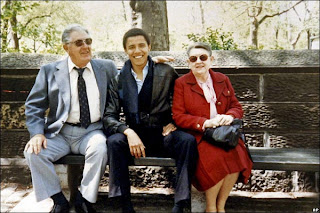
Eventually Mr Obama moved back to Hawaii to live with his grandparents and attend school. He went on to study political science at Columbia University in New York, and then moved to Chicago where he spent three years as a community organiser.

In 1988 he left to attend Harvard Law School, where he became the first African-American president of the Harvard Law Review.

He married Michelle Robinson, a fellow Harvard Law School graduate, in 1992 and they now have two young daughters, Malia and Sasha.
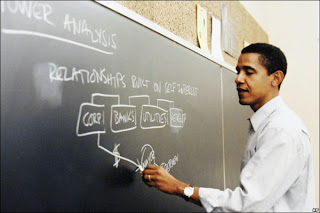
After Harvard, Mr Obama returned to Chicago to practise civil rights law, representing victims of housing and employment discrimination. He served in the Illinois state senate from 1996 to 2004.

It was in 2004 that he first shot to national - and international - prominence with a speech that stirred the Democratic national convention.

After his US Senate election victory in Illinois a few months later, he became a media darling and one of the most visible figures in Washington, with two best-selling books to his name.

The senator attended the Trinity United Church of Christ in Chicago for almost two decades, but broke away from it in May 2008 after controversial sermons by Trinity preachers hit the headlines.

Mr Obama clinched the Democratic nomination following a battle against former first lady Hillary Clinton - a contest that gripped the US from January to June 2008. Speaking after it became clear that he had won, Mr Obama talked of a "defining moment for our nation".

Mr Obama broke all records for fundraising during his campaign by using the internet to collect huge numbers of small donations. He has also demonstrated the ability to attract crowds of more than 100,000 people to his rallies.
 On the eve of the election Mr Obama's grandmother, Madelyn Dunham, died. He had referred to her in some of his most powerful campaign speeches. Mr Obama said: "She was a woman of extraordinary accomplishment, strength, and humility."
In victory Obama said: "If there is anyone out there who still doubts that America is a place where all things are possible, who still wonders if the dream of our founders is alive in our time, who still questions the power of our democracy, tonight is your answer."
 He added: "The road ahead will be long. Our climb will be steep. But America - I have never been more hopeful than I am tonight that we will get there."
Obamamania and Pakistan
There is no doubt that Barack Obama's resounding victory in the US presidential election is a major watershed in the US political evolution. The election of an Afro-American to the highest office of the land speaks volumes about the political maturity of its people in overcoming the prejudices of race and colour which had once bedeviled the American society. Obama's victory thus marks a clear break from the past and opens new vistas of freedom and opportunity for the American people. They can take pride justly in this milestone in the forward march of the US history.


The Obama administration will accord a higher priority to environmental issues such as global warming than was the case under the Bush presidency. In the above quoted Foreign Affairs article, Obama wrote, "As the world's largest producer of green-house gases, America has the responsibility to lead. While many of our industrial partners are working hard to reduce their emissions, we are increasing ours at a steady clip - by more than ten percent per decade."Finally, it appears from Obama's views expressed so far that a major aim of the US foreign policy under him would be to "strengthen our common security by investing in our common humanity." The United States can, therefore, be expected to allocate increased resources to development assistance and to help build up democratic institutions abroad like strong legislatures and independent judiciaries.What do these changes portend for Pakistan and its foreign policy? Terrorism will remain a high priority issue under President Obama. While Obama may succeed in his promise of withdrawing the US combat forces from Iraq by May 2010, he is likely to pay increased attention to Afghanistan and Pakistan in combating global terrorism. Obama declared previously his intention to hit Al-Qaeda targets in Pakistan's tribal areas if we are unwilling or unable to do so. However, his recent pronouncements on the subject have been more nuanced.It appears that the Obama administration would maintain pressure on Pakistan to do more. But it would also place increased emphasis on strengthening the effectiveness of the Afghan government which is seen by him as being responsible for most of Afghanistan's problems according to a recent interview given by him to MSNBC. This would leave a great deal of room for skilful diplomacy on the part of Pakistan to work out a joint strategy with the US in combating terrorism based on targeting Al-Qaeda elements, engaging moderate Taliban to isolate the extremists both in FATA and Afghanistan, paying increased attention to economic development as an essential element in the counter-terrorism strategy, and realising a new political dispensation in Afghanistan which gives the Pashtuns and the moderate Taliban their due share in the power structure in that country.Bilaterally, the Obama administration will extend increased support to the strengthening of the democratic institutions in Pakistan and enhance substantially the economic assistance to Islamabad relative to the military aid. The bill in the US Congress for raising the development assistance to Pakistan to US$1.5 billion per annum over a ten-year period, proposed by Vice President-elect Joe Biden, would obviously receive the full support of the Obama administration. Needless to add that our success in overcoming our current economic crisis and putting the country on a long-term high growth trajectory would depend more on our ability to adopt the requisite corrective measures domestically rather than on any assistance that we may receive from foreign sources.Pakistan's strategic location at the crossroads of South Asia, West Asia and Central Asia will continue to impart special importance to it from the point of view of the Obama administration. The same will be true of the way we manage our relations with India, China, Iran, Central Asian Republics and Russia. It will be a measure of the success of our diplomacy if we can manage the complexity of these relations in such a manner as would promote our essential security and economic interests, and strengthen our friendly relations with the important countries in our neighbourhood, especially China, Iran and Afghanistan, while strengthening our friendship and cooperation with the US. The tight-rope diplomacy required for the success of this manoeuvre will test severely the skills of our leadership and diplomats.India will remain the centre-piece of the US strategy for Asia under President Obama. Therefore, while one must welcome Obama's statements calling for a settlement of the Kashmir dispute, it is doubtful that his administration would bring to bear sufficient pressure on India to show the requisite flexibility for the purpose.
The writer is a retired ambassador ...E-mail: javid.husain@gmail.com
Tuesday, November 4, 2008
Pakistan is crucial to world map
Some pseudo-intellectuals are bumming around the world trashing Pakistan and the heavily skewed media is awash with reports making a dark portrayal of the future of this land of the pure. Rumours are doing rounds that Pakistan will be dismantled or erased from the world map, it will be balkanised or fragmented into multiple pieces and that it will be divested of its nuclear capability by the US-led West in collaboration with certain anti-Pakistan powers by and by. All this has made for a general feeling of doom and gloom in Pakistan.
 If we have a going-over of the case, what stands out a mile is that all these reports and rumours are highly asinine and nothing short of being hogwash. Pakistan has born to survive and it is destined to be an invaluable part of the world map for keeps. On having mature reflection, two factors come to the fore as prime guarantors of the survival of Pakistan on the world map: To start with, Pakistan has got a valiant and highly-octane military which is quick off the mark and has got peerless chutzpah to insulate the country against external aggression. General Kayani has rose to the occasion and provided the much needed leadership and sense of direction to his people at one of the most difficult times in the nation's history by sending a shot across America's bows. Pakistan's army will make mincemeat of anyone who tried to undo the sovereignty of this country. Moreover, Pakistan possesses nuclear weapons and it is no stranger to unpleasant situations. It has already fought three conventional wars with another nuclear nation next door.The other most important factor is the geopolitical importance of Pakistan which acts as a bulwark against malicious and venomous designs. Being in the box-seat geopolitically, Pakistan holds all the aces and catches the sight of influential foreign powers. Several foreign powers are always keen on the sustenance of Pakistan and will definitely go an extra mile to support it in its bid for survival against the heinous motives of some other powers. This can be discussed on the following counts;Firstly Pakistan is located at the junction of great powers. The near future is going to be pregnant not only with the traditional rivalries of US and Russia but also an endless struggle between them for supremacy in regional and global politics. In such situation, the world will not only see the conflict of interests between US and Russia but also efforts by them to make as many friends as possible to solidify their position. And Pakistan will be the pivot of attraction for both powers.Secondly, Pakistan is located in close proximity to the oil rich ME countries and it can influence the shipment of oil. The icing on the cake is that it lies adjacent to the Indian Ocean, Persian Gulf and Arabian Sea. It is going to be a major player in the Central Asia geo-political game. A major geographic issue will be decisive here: both Tajikistan and Uzbekistan lack any sea access. Consequently Pakistani harbours on the Indian Ocean could function as outlets for the new Central Asian energy routes - a major stake which piques the interests of not only China and Russia but also of western powers. The US has entered Afghanistan to occupy the energy resources of Central Asia and Pakistan is well-positioned geographically to emerge as a commercial hub for land-locked Central Asia and beyond. Pakistan's seaports are equidistant from Europe and the Far East.The most vivid proof of Pakistan's geo-political importance can be gauged from the fact that it is US and NATO's trustworthy ally in the fight against terrorism. Pakistan's co-operation is critical to all US plans. The incontrovertible truth is that war against Al-Qaeda can be won only if Pakistan cooperates with NATO-ISAF forces. This is because Pakistan provides logistical support to the US in the form of fuel and ammunitions. If Pakistan ditches America at this stage in the War On Terror and closes the border to all NATO supply to Afghanistan, its enterprise in Afghanistan will be doomed to failure and it will meet a fate worse than death.Pakistan is a country whose future determines the success or failure of the whole of the region. In the mid-nineties, Yale historian Paul Kennedy called Pakistan one of the most pivotal states of the world. America thinks of India as a strategic partner for maintaining balance of power against China but Pakistan is a key to the stability of the whole world. It is central to making short work of new threats to the world. Time and again, the West has turned its back on Pakistan. This blunder should not be made again or else it may occasion horrendous consequences.
 The moment of truth
November 4 is going to experience the fight for the most covetous and powerful job on the face of the earth, as on this day Americans will plump for the man who will rule them and keep the American flag flying for the next four years. As the upshot of the US election exercises cosmic and far-reaching impact on the planet as a whole, so the unfolding of the entire election process piques the curiosity and interest of the people across the globe.The US election process stands out as being the most peculiar and arduous one in the world. Its trademark is that first candidacies are declared sometimes three years before the vacancy in the White House becomes due. This process entails hard-fought battle as a good part of time of the campaign is spent on fund-raising, since the initial viability of a candidacy is established by the dollars raised rather than any votes won.

Some candidates get knocked out before a single vote is cast, if they lag behind in the public opinion polls that prospective donors read. Another factor that flag up the otherness of the US election is that even Election Day does not bring the curtains down on the electoral process. The victor is only certified when the Electoral College meets on December 15, on the basis of the votes cast in each state in November, to formally elect the president of the United States.November 4 election will see Obama pitted against McCain. Obama is an athletic 47 and his oracy is noteworthy. People turn up in his rallies agogo as he stirs their passions and his eloquence does not leave a dry eye in the house. He comes at the policy questions with a delightful mix of intellect and pragmatism. His partisans get their jollies out of his capacity to size up the situation with aplomb and pick solutions that seem both sober and politically workable.He has got a big wish list: he would pull out troops from Iraq with dispatch and send more troops to Afghanistan; he would close the prison at Guantanamo Bay of which the people across the world have been highly disdainful and dismissive; he would work out the prevalent economic meltdown sensibly and bottom out the situation etc. The alternative candidate is McCain.

McCain, a war hero who endured years of torture in Vietnam, is not on a par with Obama both in intelligence and oratorical skills. The odds are also stacked against him respecting age. He would be the oldest first-term president if elected and he has had recurrent boots of cancer. He has a fiery temper and is a warmonger at worst. He is at best a prickly individual with neo-conservative tendencies who will do little to build bridges with the world at large. He has hawkish stands on Russia, Iraq and just about everything else. His grasp of economics and finance is also shaky and tenuous.Undoubtedly, it is the military-industrial complex comprising of arms companies and oil corporations in the US which determines the direction of the policies to be followed by the White House as it has the moxie enough to browbeat any president into submission but be that it may, the personality of the president reflects itself in multiple ways on various fronts. So let us have a brief run-down on how the US will look under Obama or McCain.If Americans will opt for Obama as president, it will achieve racial reconciliation in the US. His election will also help the US to mend fences with the rest of world, as he gives countenance to international cooperation and not aggression. Some people try to confute this point by quoting his inflammatory remarks against Pakistan during the campaign. This is all wet. The point of fact is that this is mere political jugglery to outwit his opponents and so should not be taken seriously. Obama, after getting sworn in, will think better of it and will not go for an attack on Pakistan as Pakistan has all along been the trust - worthy ally of US. How Obama can attack Pakistan when he has declaimed about talking even to Iran and Syria.Deep down, he is a pacifist. What goes more than halfway to prove this is that he had opposed the Iraq War from the word go. His surname is African, his middle name is Arabic, he has Muslim ancestry, he grew up partly in Asia and his skin colour is close to the global average. He finds himself at ease with other cultures.The evidence giving credence to this point is his trip to Asia in 1981. With a Pakistani college roommate, Muhammad Hassan Chandoo, he travelled around South Asia. During the trip, he found himself overwhelmed by Karachi. Obama says, "part of the most memorable portion of the trip was travelling to a more provincial area outside of Karachi, seeing what was essentially a feudal life."Contrarily, electing McCain will lead a lot of people of colour around the world to see Americans as more fundamentally racist than they pretend to be. McCain will also add insult to injury in the relations with other countries of the world as he is a tough-talking guy who visualises the US crossing swords with formidable foes and confronting them. He wants to keep the battle going in Iraq, speaks of bombing Iran and intends to pursue a tough foreign policy with reference to North Korea. He also wants to leave Russia out in the cold and humiliate China on various fronts. His visceral attitude and mercurial temperament will make the matters take a turn for the worse. To put it mildly, McCain is the wrong man for the White House at this critical juncture.The biracial and Hawaii - born Obama's candour and judicious quality of decision making should win him the White House. However, it is the Americans who will make a choice. But they need to think long and hard before exercising their right of franchise.
Subscribe to:
Posts (Atom)