The Quran urges the faithful to, think, ponder, reflect and acquire knowledge that would bring them closer to God and to His creation.
The Quran uses repetition in order to imbed certain key concepts in the consciousness of its listeners. Allah (God) and Rab (the Sustainer) are repeated 2,800 and 950 times respectively in the sacred text; Ilm (knowledge) comes third with 750 mentions.
The prophet Muhammad commanded knowledge upon all Muslims, and urged them to seek knowledge as far they could reach, and also to seek it at all times.
Following these commands and traditions, Muslim rulers insisted that every Muslim child acquired learning, and they themselves gave considerable support to institutions, and learning in general. This contributed largely with the commands of Islam to make elementary education almost universal amongst Muslims. `It was this great liberality,' says Wilds `which they [the Muslims] displayed in educating their people in the schools which was one of the most potent factors in the brilliant and rapid growth of their civilisation. Education was so universally diffused that it was said to be difficult to find a Muslim who could not read or write.'
In Muslim Spain, according to Scott, there was not a village where `the blessings of education’ could not be enjoyed by the children of the most indigent peasant, and in Cordoba were eight hundred public schools frequented alike by Muslims, Christians, and Jews, and where instruction was imparted by lectures. The Spanish Muslim received knowledge at the same time and under the same conditions as the literary pilgrims from Asia Minor and Egypt, from Germany, France, and Britain. And in the great Muslim university of Cordoba, both Jews and Christians attained to acknowledged distinction as professors. So high was the place of learning that both teachers and pupils were greatly respected by the mass of the population; and the large libraries collected by the wealthy landed and merchants showed that learning—as in the Italian Renaissance (six hundred years later)—was one of the marks of a gentleman.
`In scarcely any other culture,’ Pedersen holds, has the literary life played such a role as in Islam. Learning (ilm), by which is meant the whole world of the intellect, engaged the interest of Muslims more than anything…. The life that evolved in the mosques spread outward to put its mark upon influential circles everywhere.'
Every place, from the mosque to the hospital, the observatory, to the madrassa was a place of learning. Scholars also addressed gatherings of people in their own homes. Al-Ghazali, Al-Farabi, and Ibn Sinna, amongst many more, after teaching in public schools, retired to their private libraries and studies, and continued teaching `those fortunate enough to be invited.'
This universality, not even equalled today, thirst and impetus for education was proper to those days, when Islam was the banner, and like most achievements only proper to those days, and none others. The role and place taken by knowledge in that era will be considered (God willing) in subsequent works. Here, focus will be on the organisation of education, its aims and methods, above all the role of the Mosque. That of the madrassa, another lengthy subject, will be covered subsequently.
The mosque played a very great part in the spread of education in Islam. For Tibawi, the association of the mosque with education remains one of its main characteristics throughout history. For Scott, the school became an indispensable appendage to the mosque. From the start, the mosque, Wardenburg explains, was the centre of the Islamic community, a place for prayer, meditation, religious instruction, political discussion, and a school. And anywhere Islam took hold, mosques were established, and basic instruction began. Once established, such mosques could develop into well known places of learning, often with hundreds, sometimes with thousands of students, and frequently contained important libraries.
The first school connected with a mosque, was set up at Medina in 653, whilst the first one in Damascus dates from 744, and by 900 nearly every mosque had an elementary school for the education of both boys and girls. Children usually started school at five, one of the first lessons in writing was to learn how to write the ninety-nine most beautiful names of God and simple verses from the Quran. After the rudiments of reading and writing were mastered, the Quran was then studied thoroughly and arithmetic was added. For those who wanted to study further, the larger mosques, where education was more advanced, offered instruction in Arabic grammar and poetry, logic, algebra, biology, history, law, and theology. Although advanced teaching often took place in madrassas, hospitals, observatories, and the homes of scholars, in Spain, teaching took place mostly in the mosques, starting with the Cordoba mosque in the 8th century.
The basic format of mosque education was the study circle, better known in Islam as `Halaqat al-ilm' or in brief: Halaqa. Halaqa, spelled Halka in the new edition of the Encyclopaedia of Islam, is defined as `a gathering of people seated in a circle,’ or, `gathering of students around a teacher. Visiting scholars were allowed to sit beside the lecturer as a mark of respect, and in many Halaqat a special section was always reserved for visitors. Al-Bahluli (d.930) a magistrate from a town in Iraq went down to Baghdad, accompanied by his brother, to make a round of such study circles. The two of them came upon one where a scholar `aflame with intelligence,’ was taking on all comers in various fields of knowledge. Ibn Battuta, recorded that more than five hundred students attended the Halaqat of the Ummayad mosque. The Mosque of Amr near Cairo had more than forty halaqat at some point, and in the chief mosque of Cairo, there were one hundred and twenty halaqat. The traveller, geographer Al-Muqaddasi, reports that between the two evening prayers, as he and his friends sat talking, he heard a cry `Turn your faces to the class’ and he realised he was sitting between two classes; altogether there were 110. During the halaqats, whilst teachers exercised authority, students were still allowed, in fact, encouraged to discuss and even challenge and correct the teacher, often in heated exchanges. Disputations, unrestricted, in all fields of knowledge were known to take place on Friday in the study circles held around the mosques, and `no holds were barred.’
Teaching and learning in most large mosques became according to Mackensen, `a fully fledged profession,’ and the mosque school took on the semblance of an academy or even a university later on. So important centres of higher learning, indeed, that many of them still exist today as the oldest universities in the world. Amongst these, Al-Qayrawwan and Al-Zaytuna in Tunisia, Al-Azhar in Egypt, and Al-Qarawiyyin in Fez, Morocco. As places of renown, they attracted great names of Muslim scholarship, either as students, or teachers, or both. Many among the graduates of the mosques of Muslim Spain were Ibn Roshd, Ibn Al-Sayigh, and Ibn Bajja. In Basra (Iraq) Al-Khallil Ibn Ahmad gave lectures on philosophy at a mosque, and one of his students was Sibawaih who later became one of the most renowned Arabic grammarians of all times. From the beginning of the 9th century until our time, `the glory’ of the Qarawiyyin, it is held, was its body of scholars (ulamas).'
Among the scholars who studied and taught there were Ibn Khaldoun, Ibn Al-Khatib, Al-Bitruji, Ibn Harazim, Ibn Maymoun, and Ibn Wazzan, and possibly even the future pope Gerbert (d.1003), who later became Pope Sylvester II, and who introduced the Arabic numerals into Europe. Al-Azhar attracted Ibn Al-Haytham who lived in its quarters for a long period, whilst Ibn Khaldoun taught there towards the end of the fourteenth century, and Al-Baghdadi taught medicine at the end of the 12th century.
The renown of such places attracted large numbers of students. In large numbers they flocked to the Mosque of Medina, which had one of the earliest and most advanced school. Al Qarawiyyin attracted scores of students from all over Morocco, the rest of North Africa, Andalusia and even the Sahara. Generally they were housed by the successive Moroccan dynasties and the people of Fes. The universities of Granada, Seville and Cordoba were held in the highest estimation by the scholars of Asia, Africa and Europe, and in the ninth century, in the department of theology at Cordoba, alone, four thousand students were enrolled, and the total number in attendance at the University reached almost eleven thousand. And on the eve of the British occupation, in Al-Azhar, were already 7600 students and 230 professors.
In the early Islamic era, the mosque was used for the teaching of one or more of the Islamic sciences and literary arts, but after the mid ninth century, more and more came to be devoted to the legal sciences. Scientific subjects were also delivered, and included astronomy and engineering at Al-Azhar, medicine also at Al-Azhar and the mosque of Ibn Tulun in Egypt. At the Qarawiyyin, there were courses on grammar, rhetoric, logic, elements of mathematics and astronomy, and possibly history, geography and elements of chemistry. At Qayrawwan and Zaytuna in Tunisia, alongside the Quran and jurisprudence were taught grammar, mathematics, astronomy and medicine. At Qayrawwan, in particular, classes in medicine were delivered by Ziad ibn Khalfun, Ishak ibn Imran and Ishak ibn Sulayman, whose works were subsequently translated by Constantine The African in the 11th century. They were taught in the first faculty of medicine in Europe: Salerno, in the South of Italy, which became the first institution of high learning in Latin Europe. At the Mosque of Amr, the Muslim traveller-geographer Al-Muqaddasi from Jerusalem reports that between the two evening prayers, the mosque was crowded with classes in law, the Quran, literature and wisdom (philosophy or ethics). Whilst in Iraq, pharmacology, engineering, astronomy and other subjects were taught in the mosques of Baghdad, and students came from Syria, Persia and India to learn these sciences.
The mosques gradually took on wider functions on top of learning. Tracing this evolution, George Makdisi states that in the tenth century there was a flourishing of a new type of college, combining the masjid with a khan or inn to lodge law students from out of town. The great patron of this second stage in the development of the college was Badr ibn Hasanawaih (d. 1014/1015), governor of several provinces under the Buyids, and to whose name 3,000 masjid-khan complexes were credited over the thirty-year period of his governorship. The reason for the masjid-khan complex, Georges Makdisi explains, was that the student of law had to pursue over a long period, usually four years for undergraduate studies alone, and an indeterminate period for graduate studies, often as many as twenty years, during which the graduate disciple assisted the master in teaching. The masjid could not be used for lodging, except under special circumstances, the inn or khan thus became the lodging place of the staff and students and was founded in proximity to the masjid. The madrasa, which will be considered at a further stage, was, according to Makdisi, the final stage in the development of the Muslim college, combining the teaching function of the masjid with the lodging function of the khan. This follows a tradition long established by prophet Muhammad whose mosque was connected to a building which served as a school and as a hostel for poor students and out-of-towners.
Assistance for students in the various mosques was substantial. At the Qarawiyyin, for instance, students were not only exempt from paying fees but were also given monetary allowances periodically. Bayard Dodge states that, there, the students lived in residential quadrangles, which contained two and three story buildings of varying sizes, accommodating between sixty and a hundred and fifty students, who all received a minimal assistance for food and accommodation. The number of students at Al-Azhar was always high, Al-Maqrizi mentioning 750 foreign students from as distant lands as the Maghreb and Persia at one time residing in the mosque, in addition to students from all parts of Egypt. Bayard Dodge states that those students who did not have homes in Cairo, each was assigned to a residential unit, which was endowed to care for him. Generally, the unit gave the resident students free bread, which supplemented food given to them by their families, whilst better off students could afford to live in lodgings near the mosque. Every large unit also included a library, kitchen and lavatory, and some space for furniture. On his visit to Damascus, the traveller, Ibn Jubair reported the high number and varied facilities for foreign students and visitors at the Umayyad Mosque, prompting him to declare that `Anyone in the West who seeks success, let him come to this city (Damascus) to study, because assistance here is abundant. The chief thing is that the student here is relieved of all worry about food and lodging, which is a great help.'
The rulers played a major part in the endowment of mosques for education purposes. At the Qarawiyyin were three separate libraries, the most prestigious of which being the Abu Inan Library, founded by the Merinid Sultan, Al-Mutawakkil Abu Inan. An avid reader and collector, the Sultan deposited in his newly founded library books on various subjects that included religion, science, intellect and language, and he also appointed a librarian to take charge of the affairs of the library. In Tunisia, when the Spaniards occupied Tunis between 1534 and 1574, they ransacked its mosques and libraries, and removed many of the precious books and manuscripts. The Ottomans subsequently expelled the Spaniards, and restored and expanded the Zaytuna mosque, its libraries and madrassa, and made it again a high centre of Islamic culture. In Cairo, in 1365, the Mamluke prince, Yalbagha Al-Umari, ordered that each student at the mosque of Ibn Tulun be given forty dirhams and one irdab of wheat every month. The Mamlukes also paid the salaries and stipends to large numbers of teachers and students. This trend was particularly encouraged by Sultan Husam Al-Din Lajin, who restored the Mosque of Ibn Tulun in the Qatayi district of Cairo, paying salaries for professors and stipends for students, and having the royal physician Sharaf Al-Din Muhammad Ibn Al-Hawafir deliver in it lectures on medicine.
The following tale enlightens us greatly on education and Muslim life of then.. When Ibn Tulun ruled Egypt, some students attended the class of a professor who dictated daily such a small portion of tradition that their money ran out before the course was finished. To buy food they had to sell everything they had. After starving for three days, they resorted to begging. None of them wanted to face such disgrace, though. So they cast the lot, and the one who lost went into a corner of the mosque where they lived and asked God to be released from this shame. Just then a messenger came from Ibn Tulun with money for he had been warned in a dream to help them; there was also a message that he would visit them in person the next day. To avoid this honour, which might have been thought as a desire for personal glory, the students fled from Cairo that night. Ibn Tulun bought the whole of that ward and endowed the mosque with it for the benefit of students and strangers residing in it.
In more than one respect Islam influenced Europe and subsequently the rest of the world with its system of education, including universality and its methods of teaching and granting diplomas. Georges Makdisi shows this adequately, and raises some crucial points in this respect. Amongst others, Islam influenced the West and the course of university scholarship in terms of academic freedom of professors and students, in the doctoral thesis and its defence, and in the peer review of scholarly work based on the consensus of peers. The open scholarly discussions in the mosques surely accounted for much of that in times when scientific intolerance ruled elsewhere, and any free scholarly thought was punished with burning at the stake. The influence also came in the form of the many translated books of Islamic scholars which formed the core of European education in their first universities (Montpellier, Bologna, Paris, Oxford…), which all were founded in the twelfth-thirteenth centuries.
Islam and knowledge went together, closely, and from the very early stages. Other than the urge of the Quran and the sayings of the prophet Muhammad which prompted people to learn, the concrete symbol of Islam, the Mosque, was the centre of learning. And, indeed, until now, in most parts of the Islamic world, the word Jamia means at once both mosque and school, even when they are separate buildings, most often distant from each other. Finally, `Jamia’, the word for university in Arabic derives from Jami, mosque. No similar derivation exists in any other language or culture; no better association between Islam and higher learning than this.
Sunday, March 29, 2009


Saturday, March 14, 2009
legal news
Lawsuit is a website which gives you splendid legal advices,If you are having problem in your life like,you arenot happy with your wife or other issues which you have been facing in your life so they all can be solved if you get suggestion from lawsuit lawyer because they are having professional exprience in law so they can solve your all the problems of your life legally ,this is the official link of lawsuit http://www.lawsuit.com/ you can find a lawyer online even though you get can a free case evaluation.after clicking on the given link you can also find some videos over there which are covering topics like Mesothelioma,Medical Malpractice Lawsuits and others.
Medical Malpractice provides you a Medical Malpractice lawyer online:
thousands of americans patients are being treated illegally probably they are dying just because of medical mistakes even though 40 doctors were responsible for over 25% of all medical malpractice cases in few states. if you or someone of you was being victim of medical Malpractice you should contact a Medical Malpractice lawyer online for getting your compensation that you deserve you dont waste your time just click here http://www.lawsuit.com/pa/medical-malpractice.html.
Mesothelioma Attorneys and Lawsuits:Mesothelioma is a disease which can be found in cells of the mesothelium and you would become abnormal and divide without control or order. They can invade and damage nearby tissues and organs. Cancer cells can also be (spreaded) from their original site to other parts of the body. Most cases of mesothelioma begin in the pleura or peritoneum. If you or someone of you has been diagnosed with Mesothelioma, please contact lawsuit service today. they can help put you in touch with experienced attorneys who are knowledgeable in this area and can help you with your claim.so dnt waste your time just click here : http://www.lawsuit.com/pa/mesothelioma.html
Medical Malpractice provides you a Medical Malpractice lawyer online:
thousands of americans patients are being treated illegally probably they are dying just because of medical mistakes even though 40 doctors were responsible for over 25% of all medical malpractice cases in few states. if you or someone of you was being victim of medical Malpractice you should contact a Medical Malpractice lawyer online for getting your compensation that you deserve you dont waste your time just click here http://www.lawsuit.com/pa/medical-malpractice.html.
Mesothelioma Attorneys and Lawsuits:Mesothelioma is a disease which can be found in cells of the mesothelium and you would become abnormal and divide without control or order. They can invade and damage nearby tissues and organs. Cancer cells can also be (spreaded) from their original site to other parts of the body. Most cases of mesothelioma begin in the pleura or peritoneum. If you or someone of you has been diagnosed with Mesothelioma, please contact lawsuit service today. they can help put you in touch with experienced attorneys who are knowledgeable in this area and can help you with your claim.so dnt waste your time just click here : http://www.lawsuit.com/pa/mesothelioma.html
Thursday, March 12, 2009
FUTURE OF A POOR
For a few hours ago,I went airport hotel for taking a cup of tea with my best friend jawad in the meanwhile there was an 11 years old boy who was cleaning some parked cars for a bit of money,who came to me and requested me sir may i clean your car,i replied no then i gave him 8 rupees then he said: sir i am not a beggar,I will get the money if you allow me to clean your car otherwise put the money off in your pocket,I cant say it was his arrogance or attitude but he impressed me then an impatient desire rose into my heart that why not i took his interveiw and publish the interveiw on my blog.Therefore,I asked his name,what is your name : he replied umer,what do u do umer besides cleaning cars: he replied nothing sir,what is your father umer: he replied sir my father passed away when i was 5 years old,so sorry then i asked him,how many brothers are you: he replied i have only one brother,oh then i asked who is your representator who manage your family: he replied sir my mother but now adays i am alone because she is hospitalised and my little brother is with her then i said him why you are here you should be with your mother: he replied sir i am cleaning the car for the sake of my mother's health afterwards I asked him ,What is your dream? he replied : sir i will buy my own buss and do my own transport business ,then I said Inshallah u will get all things of the world.then my friend came and asked me what are you doing waqar i replied him,jawad i am talking with this boy then again jawad asked him what is your name : he replied OSAMA inthemeantime i replied umer then jawad asked him what is your real name: Either Umer or Osama then sadly he replied sir my name is Osama but i dont want to tell anyone my real name because a couple months ago someone asked my name,I told him sir my name is Osama then the person replied Bastard your name is so much notorious in the whole world as people know OSAMA BIN LADEN ,and for your kind of information Osama was the person who attacked on america in 9/11 on WTC tower that is why i proclaim often to people that my name is umer,Well suddenly i thought i must take some pictures of this boy.
these all pictures had been taken by my cellfone while his interveiw was taken.
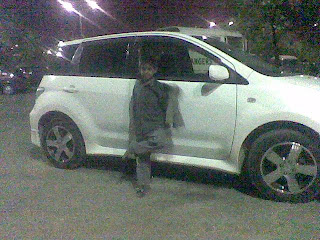


 Eventually he will never get education ever becuase he can't afford even though he cleans cars just for the sake of his mother and his family.more than thousands of stories are in pakistan like this story,but no one takes care of them besides Rich people are behaving with them abominably when they say them, please for the sake of Allah give us only 1 rupees.Now you say me by your comments that what is the future of a poor.
these all pictures had been taken by my cellfone while his interveiw was taken.
Eventually he will never get education ever becuase he can't afford even though he cleans cars just for the sake of his mother and his family.more than thousands of stories are in pakistan like this story,but no one takes care of them besides Rich people are behaving with them abominably when they say them, please for the sake of Allah give us only 1 rupees.Now you say me by your comments that what is the future of a poor.
Monday, March 9, 2009
Dreamt a Dream
Having completed Islamiat notes for css-2010 exam, I went to sleep. I found myself sitting in a coach bound from Karachi to Lahore. I started to pen down every interesting moment that came to my attention during my journey. After passing along the forest area, the coach pulled the couch to the sidewalk at the signal of a policeman for routine check up. All of a sudden, a beggar got on the coach and occupied a seat near me. At first his behavior with me was cordial and I found him a quiet person. But then I noticed that he was gazing at me for no particular reason. I found his behavior quite weird. It was creepy. It made me wonder as to what is so strange about me that had caught his eyes. Another peculiar thing about him was that his dress was made of rags of different worn out colors. Finding m scared, he started the conversation. He said, " Hello Waqar, why do u look so afraid? I am your friend and there is nothing to be scared of. I m the same person u have been calling for. I sensed that he knew what was going in my mind when he said," Waqar, i find you like a man who is fighting his destiny. I can see that you will ultimately be successful in the end. Learn to fight your fears." I was completely surprised to know that he could read my mind so well. At that particular moment, he vanished away into nothingness. It looked like an illusion. But I thought he was " light " of my vision. I got up and found myself in my room. It was dreaming!! I was out of my wits. But I sensed that that dream carried many portents. The conversation of that beggar pointed to my future life. Well guys, I have never dreamed like this before. Indeed, the longing for him is still in my heart. I want to meet him again and ask him to tell me the secrets of life. Perhaps he wanted me to believe in my fate and strive to achieve it, never giving up like a loser.
Wednesday, February 18, 2009
Paulo Coelho
A writer,Who is prominent,who writes slendid on different issues and whom i am inspired,Well i am not mere a one person who reads his novels but all over the world his novels are being read.
I dont know much about other readers,why they are reading his novels rather i can say about my self that he is a good writer as well as nice chap.
His first Novel was "The Pilgrimage " In 1986, Paulo Coelho sets out for The Pilgrimage towards Santiago de Compostela. "In those days –says the author-, my spiritual quest was linked to the idea that there were secrets, mysterious ways, and people capable of understanding and controlling things which would be unavailable to most mortals. I thought that what leads us to grasping the mystery of life, must be difficult and complicated." This journey becomes a truly initiatory experience, and Paulo is transformed for ever as he learns to understand the nature of truth through the simplicity of life: he learns that "the extraordinary is always found in the way of the common people." As a writer, he devotes himself to show, in a plain and fluid style, the richness of our inner reality with the intention of sharing his experiences with all of us. Thus, The Pilgrimage has a very important place in the work, not just because it is the first of his major books, after which came The Alchemist, but because of the complete way in which it expresses the humanity of Paulo's philosophy and the depth of his search.


His another book whose copies sold around the world "The Alchemist in 1988"The book that makes the world dream.When you want something, the whole Universe conspires to help you realize your dream.Santiago, the hero of the novel, already forms part of a select gallery of illustrious characters and leads us through his story to experience a remarkable adventure.“When I wrote The Alchemist, I was trying to understand the reason for the existence of life. Instead of writing a philosophical treatise, I decided to converse with the child inside my soul.To my surprise, this child was living inside millions of people around the world. With this book I wanted to share with my readers the questions which, precisely because they don't have an answer, make life a great adventure”. - Paulo Coelho
Brida in 1990“In Brida, my third novel which I wrote just after The Alchemist, I tell the story of a young woman that dives into sorcery and experiences with different magical traditions. I explore many themes that are dear to me, such as The Great Mother, pagan religions and the perceptions of love.When I wrote this book and published it in Brazil more than 18 years ago, themes such as the feminine face of God were still very foreign to most people. Nevertheless, I noticed, with the passing of time, a shift in perception – people being more open to the intuitive perception of the world and being less seduced by the fixed rules of society. As written on the book, "the noblest thing a human being can experience is acceptance of the mystery.I have the feeling that the world is accepting more and more the mystery and so, dear readers, I present you the story of this young woman today." Paulo CoelhoWould you be willing to sacrifice everything for the man or woman of your life?This is the story of Brida, a beautiful young Irish girl, and her quest for knowledge. On her journey she meets a wise man who teaches her about overcoming her fears, and a woman who teaches her how to dance to the hidden music of the world. They see in her a gift, but must let her make her own voyage of discovery.As Brida seeks her destiny, she struggles to find a balance between her relationships and her desire to transform herself.Brida is a moving tale of love, mystery and courage, of the the spiritual side of eros and the erotic side of spirituality.
O Dom Supremo: The Greatest Gift in 1991
Based on the book "The Greatest Thing in the World", in which the priest Henry Drummond discourses on a section of St. Paul's letter to the Corinthians.
 The Valkyries in 1992
Why is it that we destroy the things we love most? This is the question Paulo Coelho faces in this story of his confrontation with his past. 'The Valkyries' is a compelling account of his journey, as Paulo and his wife embark on a forty day quest into the searing heat of the Mojave Desert, where they encounter 'The Valkyries', strange warrior women who travel the desert on motorcycles. This is not only a modern day adventure, it is also an exploration of one man's battle with self doubt and fear, as well as a true story of two people striving to understand one another through adversity. Ultimately, 'The Valkyries' delivers a powerful message about forgiving our past and believing in our future.
Maktub in 1994
Maktub is a collection of stories, parabolas that don't pretend to constitute an apprenticeship but offer a coloured treasure of fragmented wisdom from different cultures. Those short stories, inspired to the writer by vary different sources and folklores, were born from Paulo Coelho's collaboration with the daily Folha de São Paulo. Coelho selected texts published between June 1993 and June 1994, to offer readers around the world this Maktub, which deepens through the prism of a universal mosaic of oral tradition. According to Paulo Coelho himself, "Maktub is not an advice book, but an exchange of experiences", an excellent occasion to reflect and meet oneself again.
By the River Piedra I Sat Down and Wept in 1994
In all stories of love there is always something that moves us closer to eternity and the essence of life because the stories of love hold within all the secrets in the world. But what happens when shyness prevents an adolescent love affair from developing? And what happens when, 11 years later, destiny brings the lovers together again? In the meantime, life has taught her to be strong and to hide her feelings. As for him, he is now a handsome spiritual teacher – with a reputation for performing miracles – who has turned to religion as a refuge from his inner conflicts.Together they take a journey that is initially fraught with difficulty as blame and resentment resurface after years of being hidden. But by the River Piedra, in a small village in the French Pyrenees, they find a way to discuss many of life's big questions and re-evaluate their won special relationship.By The River Piedra is a wonderful novel, with a poetic and transcendent narrative, that reflects all the mysteries of love and life.
The Fifth Mountain in 1996
"There are inevitable moments of misfortune which interrupt our lives. However, they happen for a reason." Sometimes the world seems to have conspired against us, and so we ask ourselves, "Why does this have to happen to me?" Confronted by the inevitable, some of us become discouraged; others, however, grow stronger and increase their understanding.The story of the prophet Elijah is an invaluable lesson of hope for the contemporary man. To what point can we predict our own destiny? This is the question that hangs in the air over The Fifth Mountain, and every one of us has tried to grasp it.Evoking all the drama and intrigue of the colourful, chaotic world of the Middle East, Paulo Coelho turns the trials of Elijah into an intensely moving and inspiring story – one that powerfully brings out the universal themes of how faith and love can ultimately triumph over.
Love Letters from a Prophet in 1997
Our perception of life is influenced with the tradition and standards which are considered correct. The big challenge is to discover our authentic self, by asking questions and searching for answers. The work of Kahlil Gibran has helped many of the ones who are searching for these questions and enjoying the adventure of personal discovery. But where the kindness of soul of Kahlil Gibran is revealed is in his letters to Mary Haskell, a great love of his life.Aiming to uncover the man who stands behind The Prophet, Paulo Coelho, the author of The Alchemist, has compiled a part of this intimate correspondence. In it, Gibran reveals an internal world of pain and laughter which served as the force for the inspiration of his beautiful work.
The Manual of the Warrior of the Light in 1997
The Manual of the Warrior of Light, presents a collection of philosophical thoughts and stories that will delight seekers everywhere. A warrior of the light does not spend his days trying to play the role that others have chosen for him. A warrior of the light does not waste his time listening to provocations; he has a destiny to fulfil. A warrior of the light knows his own faults, but he also knows his own qualities. A warrior of the light always does his best and expects the best of others. A warrior knows that the farthest-flung star in the Universe reveals itself in the things around him. The Manual of the Warrior of the Light is an invitation to each of us to live our dream, to embrace the uncertainty of life, and to rise to meet our own unique destiny. In his inimitable style, Paulo Coelho helps us to discover the warrior of the light within each of us. With inspiring short passages, we are invited to embark upon the way of the warrior: the one who appreciates the miracle of being alive, the one who accepts failure and the one whose quest leads him to become the person he wants to be.
Veonika Decides to Die in 1998
Veronika seems to have everything she could wish for. She goes to popular night spots, she meets and dates attractive young men and yet she's not happy. Something is lacking in her life. That's why, in the morning of 11th November 1997, Veronika Decides to Die. After taking an overdose, Veronika is told she has only a few days to live.This story follows Veronika through these intense days as to her surprise, she finds herself drawn into the enclosed world of the local hospital she is staying in. In this heightened state she discovers things she has never really allowed herself to feel before: hatred, fear, curiosity, love - even sexual awakening. Her experiences lead her gradually to realise that every second of her existence is a choice between living and dying. Paulo Coelho's new book is about those who do not fit into patterns considered normal by society. It is about madness and the need to find an alternative way of living for people who frequently have to face other people's prejudices because they think in a different way.
The Devil and Miss Prym in 2000
A community devoured by greed, cowardice and fear. A man persecuted by the ghosts of his painful past. A young woman searching for happiness. In one eventful week, each of them will face questions of life, death and power, and each of them will have to choose their own path. Will they choose good or evil? The remote village of Viscos is the setting for this extraordinary struggle. A stranger arrives, carrying with him a backpack containing a notebook and eleven gold bars. He comes searching for the answer to a question that torments him: are human beings, in essence, good or evil? In welcoming the mysterious foreigner, the whole village becomes an accomplice to his sophisticated plot, which will forever mark their lives. In this stunning new novel, Paulo Coelho dramatizes the struggle within every soul between light and darkness, and its relevance to our everyday struggles: to dare to follow our dreams, to have the courage to be different and to master the fear that prevents us from truly living. The Devil and Miss Prym is a story charged with emotion, in which the integrity of being human meets a terrifying test.
Eleven Minutes in 2003
"Once upon a time, there was a prostitute called Maria…" Like a fairy-tale for adults, this is the beginning of the novel that shook the world. “Eleven Minutes does not intend to be a manual or a treatise on men and women faced by the still unknown world of sexual relationships. It is an analysis of my own journey, without wanting, at any time, to judge what I experienced.I wrote this book in order to discover whether I had had the courage to learn everything life had taught me in this respect.” - Paulo Coelho
The Zahir in 2005
It begins with a glimpse or a passing thought. It ends in obsession .One day a renowned author discovers that his wife, a war correspondent, has disappeared, leaving no trace. Though time brings more success and new love, he remains mystified – and increasingly fascinated – by her absence. Was she kidnapped, blackmailed, or simply bored with their marriage? The unrest she causes is as strong as the attraction she exerts.His search for her – and for the truth of his own life – takes him from France to Spain, Croatia and, eventually, the bleakly beautiful landscape of Central Asia. More than that, it takes him from the safety of his world to a totally unknown path, searching for a new understanding of the nature of love and the power of destiny. With The Zahir, Paulo Coelho demonstrates not just his powerful and captivating storytelling, but also his extraordinary insight into what it is to be a human being in a world full of possibility.
Like the Flowing River in 2006
Rather like a cross-section of Paulo Coelho’s literary work, Like the Flowing River is a compilation of tales, opinions and ideas drawn from articles published in various newspapers between 1998 and 2005.“The pages in this book describe moments I have lived, stories I was told, and thoughts I’ve had at every stage of the river of my life” - Paulo Coelho
The Witch of Portobello in 2006
Who is this mysterious woman called Athena? The orphan abandoned by her gypsy mother in Transylvania. The child taken to Beirut by her adoptive parents. The clerk working in a large bank in London. The successful real estate agent in Dubai. The priestess of Portobello Road.
“I wanted to explore the feminine side of divinity, I wanted to plunge into the heart of the Great Mother. I felt the need to question why society had tried to lock away the feminine side of God. But why explore the feminine side of God? People sometimes ask me if I believe in witches, to which I always answer: I do. Unfortunately the word “witch” still has many bad connotations. To me, a witch is a woman who is capable of letting her intuition guide her actions, one who communes with her environment, who isn’t afraid of facing challenges. I wanted to talk about the prejudice that modern witches face in modern society” - Paulo Coelho
The Magician, Fernando Morais in 2008
The incredible story of Paulo Coelho, the boy who was born dead, flirted with suicide, suffered at mental asylums, dove into drugs, tried several varieties of sex, met the devil, was arrested during the dictatorship, helped revolutionize Brazilian rock, rediscovered his faith and became one of the most-widely read writers in the world. Paulo Coelho de Souza was born in the rainy wee hours of August 24th in..."Fernando Morais, the author that helped establish the biography as a literary gender in Brazil centers his investigative verve on the Brazilian personage that has become the great myth of Brazil's recent history: Paulo Coelho -a universal writer that reached the astronomical mark of 100 million sold books and the achievement of being the most translated living author in the whole planet. The Magician is the eletrifying path of the popstar that is requested by princes, sheikhs, queens and presidents. A story that not even the most creative screenwriters would be able to dream of.
The Winner Stands Alone in 2008
He never breaks a promise.Igor Malev has one thing on his mind - his ex-wife Ewa. He's handsome, rich, and effortlessly personable - but she left him for a successful fashion designer, a sting he's never recovered from.So he travels to the glamorous Cannes International Film Festival where they'll be appearing, intent on winning back her love. But Igor is a man of rare intensity and cold intelligence - and this is to be no ordinary reconciliation. For Igor made a promise to destroy whole worlds to get to his beloved. Now, the conflict between an individual evil force and society emerges as the novel unfolds, and as morality is derailed.And he always keeps his word.A profound meditation on personal power and innocent dreams that are manipulated or undone by success, The Winner Stands Alone is set in the exciting worlds of fashion and cinema.Meet the players and posers behind the scenes at Cannes - the "Superclass" of producers, actors, designers and supermodels, as well as the aspiring starlets, has-been stars, and jaded hangers-on. Adroitly interweaving the characters' connected stories, Paulo Coelho uses his twelfth novel to paint an engrossing picture of a world overrun by glamour and excess, and shows us the possibly dire consequences of our obsession with fame.
I dont know much about other readers,why they are reading his novels rather i can say about my self that he is a good writer as well as nice chap.
His first Novel was "The Pilgrimage " In 1986, Paulo Coelho sets out for The Pilgrimage towards Santiago de Compostela. "In those days –says the author-, my spiritual quest was linked to the idea that there were secrets, mysterious ways, and people capable of understanding and controlling things which would be unavailable to most mortals. I thought that what leads us to grasping the mystery of life, must be difficult and complicated." This journey becomes a truly initiatory experience, and Paulo is transformed for ever as he learns to understand the nature of truth through the simplicity of life: he learns that "the extraordinary is always found in the way of the common people." As a writer, he devotes himself to show, in a plain and fluid style, the richness of our inner reality with the intention of sharing his experiences with all of us. Thus, The Pilgrimage has a very important place in the work, not just because it is the first of his major books, after which came The Alchemist, but because of the complete way in which it expresses the humanity of Paulo's philosophy and the depth of his search.
His another book whose copies sold around the world "The Alchemist in 1988"The book that makes the world dream.When you want something, the whole Universe conspires to help you realize your dream.Santiago, the hero of the novel, already forms part of a select gallery of illustrious characters and leads us through his story to experience a remarkable adventure.“When I wrote The Alchemist, I was trying to understand the reason for the existence of life. Instead of writing a philosophical treatise, I decided to converse with the child inside my soul.To my surprise, this child was living inside millions of people around the world. With this book I wanted to share with my readers the questions which, precisely because they don't have an answer, make life a great adventure”. - Paulo Coelho
Brida in 1990“In Brida, my third novel which I wrote just after The Alchemist, I tell the story of a young woman that dives into sorcery and experiences with different magical traditions. I explore many themes that are dear to me, such as The Great Mother, pagan religions and the perceptions of love.When I wrote this book and published it in Brazil more than 18 years ago, themes such as the feminine face of God were still very foreign to most people. Nevertheless, I noticed, with the passing of time, a shift in perception – people being more open to the intuitive perception of the world and being less seduced by the fixed rules of society. As written on the book, "the noblest thing a human being can experience is acceptance of the mystery.I have the feeling that the world is accepting more and more the mystery and so, dear readers, I present you the story of this young woman today." Paulo CoelhoWould you be willing to sacrifice everything for the man or woman of your life?This is the story of Brida, a beautiful young Irish girl, and her quest for knowledge. On her journey she meets a wise man who teaches her about overcoming her fears, and a woman who teaches her how to dance to the hidden music of the world. They see in her a gift, but must let her make her own voyage of discovery.As Brida seeks her destiny, she struggles to find a balance between her relationships and her desire to transform herself.Brida is a moving tale of love, mystery and courage, of the the spiritual side of eros and the erotic side of spirituality.
O Dom Supremo: The Greatest Gift in 1991
Based on the book "The Greatest Thing in the World", in which the priest Henry Drummond discourses on a section of St. Paul's letter to the Corinthians.
The Valkyries in 1992Why is it that we destroy the things we love most? This is the question Paulo Coelho faces in this story of his confrontation with his past. 'The Valkyries' is a compelling account of his journey, as Paulo and his wife embark on a forty day quest into the searing heat of the Mojave Desert, where they encounter 'The Valkyries', strange warrior women who travel the desert on motorcycles. This is not only a modern day adventure, it is also an exploration of one man's battle with self doubt and fear, as well as a true story of two people striving to understand one another through adversity. Ultimately, 'The Valkyries' delivers a powerful message about forgiving our past and believing in our future.
Maktub in 1994
Maktub is a collection of stories, parabolas that don't pretend to constitute an apprenticeship but offer a coloured treasure of fragmented wisdom from different cultures. Those short stories, inspired to the writer by vary different sources and folklores, were born from Paulo Coelho's collaboration with the daily Folha de São Paulo. Coelho selected texts published between June 1993 and June 1994, to offer readers around the world this Maktub, which deepens through the prism of a universal mosaic of oral tradition. According to Paulo Coelho himself, "Maktub is not an advice book, but an exchange of experiences", an excellent occasion to reflect and meet oneself again.
By the River Piedra I Sat Down and Wept in 1994
In all stories of love there is always something that moves us closer to eternity and the essence of life because the stories of love hold within all the secrets in the world. But what happens when shyness prevents an adolescent love affair from developing? And what happens when, 11 years later, destiny brings the lovers together again? In the meantime, life has taught her to be strong and to hide her feelings. As for him, he is now a handsome spiritual teacher – with a reputation for performing miracles – who has turned to religion as a refuge from his inner conflicts.Together they take a journey that is initially fraught with difficulty as blame and resentment resurface after years of being hidden. But by the River Piedra, in a small village in the French Pyrenees, they find a way to discuss many of life's big questions and re-evaluate their won special relationship.By The River Piedra is a wonderful novel, with a poetic and transcendent narrative, that reflects all the mysteries of love and life.
The Fifth Mountain in 1996
"There are inevitable moments of misfortune which interrupt our lives. However, they happen for a reason." Sometimes the world seems to have conspired against us, and so we ask ourselves, "Why does this have to happen to me?" Confronted by the inevitable, some of us become discouraged; others, however, grow stronger and increase their understanding.The story of the prophet Elijah is an invaluable lesson of hope for the contemporary man. To what point can we predict our own destiny? This is the question that hangs in the air over The Fifth Mountain, and every one of us has tried to grasp it.Evoking all the drama and intrigue of the colourful, chaotic world of the Middle East, Paulo Coelho turns the trials of Elijah into an intensely moving and inspiring story – one that powerfully brings out the universal themes of how faith and love can ultimately triumph over.
Love Letters from a Prophet in 1997
Our perception of life is influenced with the tradition and standards which are considered correct. The big challenge is to discover our authentic self, by asking questions and searching for answers. The work of Kahlil Gibran has helped many of the ones who are searching for these questions and enjoying the adventure of personal discovery. But where the kindness of soul of Kahlil Gibran is revealed is in his letters to Mary Haskell, a great love of his life.Aiming to uncover the man who stands behind The Prophet, Paulo Coelho, the author of The Alchemist, has compiled a part of this intimate correspondence. In it, Gibran reveals an internal world of pain and laughter which served as the force for the inspiration of his beautiful work.
The Manual of the Warrior of the Light in 1997
The Manual of the Warrior of Light, presents a collection of philosophical thoughts and stories that will delight seekers everywhere. A warrior of the light does not spend his days trying to play the role that others have chosen for him. A warrior of the light does not waste his time listening to provocations; he has a destiny to fulfil. A warrior of the light knows his own faults, but he also knows his own qualities. A warrior of the light always does his best and expects the best of others. A warrior knows that the farthest-flung star in the Universe reveals itself in the things around him. The Manual of the Warrior of the Light is an invitation to each of us to live our dream, to embrace the uncertainty of life, and to rise to meet our own unique destiny. In his inimitable style, Paulo Coelho helps us to discover the warrior of the light within each of us. With inspiring short passages, we are invited to embark upon the way of the warrior: the one who appreciates the miracle of being alive, the one who accepts failure and the one whose quest leads him to become the person he wants to be.
Veonika Decides to Die in 1998
Veronika seems to have everything she could wish for. She goes to popular night spots, she meets and dates attractive young men and yet she's not happy. Something is lacking in her life. That's why, in the morning of 11th November 1997, Veronika Decides to Die. After taking an overdose, Veronika is told she has only a few days to live.This story follows Veronika through these intense days as to her surprise, she finds herself drawn into the enclosed world of the local hospital she is staying in. In this heightened state she discovers things she has never really allowed herself to feel before: hatred, fear, curiosity, love - even sexual awakening. Her experiences lead her gradually to realise that every second of her existence is a choice between living and dying. Paulo Coelho's new book is about those who do not fit into patterns considered normal by society. It is about madness and the need to find an alternative way of living for people who frequently have to face other people's prejudices because they think in a different way.
The Devil and Miss Prym in 2000
A community devoured by greed, cowardice and fear. A man persecuted by the ghosts of his painful past. A young woman searching for happiness. In one eventful week, each of them will face questions of life, death and power, and each of them will have to choose their own path. Will they choose good or evil? The remote village of Viscos is the setting for this extraordinary struggle. A stranger arrives, carrying with him a backpack containing a notebook and eleven gold bars. He comes searching for the answer to a question that torments him: are human beings, in essence, good or evil? In welcoming the mysterious foreigner, the whole village becomes an accomplice to his sophisticated plot, which will forever mark their lives. In this stunning new novel, Paulo Coelho dramatizes the struggle within every soul between light and darkness, and its relevance to our everyday struggles: to dare to follow our dreams, to have the courage to be different and to master the fear that prevents us from truly living. The Devil and Miss Prym is a story charged with emotion, in which the integrity of being human meets a terrifying test.
Eleven Minutes in 2003
"Once upon a time, there was a prostitute called Maria…" Like a fairy-tale for adults, this is the beginning of the novel that shook the world. “Eleven Minutes does not intend to be a manual or a treatise on men and women faced by the still unknown world of sexual relationships. It is an analysis of my own journey, without wanting, at any time, to judge what I experienced.I wrote this book in order to discover whether I had had the courage to learn everything life had taught me in this respect.” - Paulo Coelho
The Zahir in 2005
It begins with a glimpse or a passing thought. It ends in obsession .One day a renowned author discovers that his wife, a war correspondent, has disappeared, leaving no trace. Though time brings more success and new love, he remains mystified – and increasingly fascinated – by her absence. Was she kidnapped, blackmailed, or simply bored with their marriage? The unrest she causes is as strong as the attraction she exerts.His search for her – and for the truth of his own life – takes him from France to Spain, Croatia and, eventually, the bleakly beautiful landscape of Central Asia. More than that, it takes him from the safety of his world to a totally unknown path, searching for a new understanding of the nature of love and the power of destiny. With The Zahir, Paulo Coelho demonstrates not just his powerful and captivating storytelling, but also his extraordinary insight into what it is to be a human being in a world full of possibility.
Like the Flowing River in 2006
Rather like a cross-section of Paulo Coelho’s literary work, Like the Flowing River is a compilation of tales, opinions and ideas drawn from articles published in various newspapers between 1998 and 2005.“The pages in this book describe moments I have lived, stories I was told, and thoughts I’ve had at every stage of the river of my life” - Paulo Coelho
The Witch of Portobello in 2006
Who is this mysterious woman called Athena? The orphan abandoned by her gypsy mother in Transylvania. The child taken to Beirut by her adoptive parents. The clerk working in a large bank in London. The successful real estate agent in Dubai. The priestess of Portobello Road.
“I wanted to explore the feminine side of divinity, I wanted to plunge into the heart of the Great Mother. I felt the need to question why society had tried to lock away the feminine side of God. But why explore the feminine side of God? People sometimes ask me if I believe in witches, to which I always answer: I do. Unfortunately the word “witch” still has many bad connotations. To me, a witch is a woman who is capable of letting her intuition guide her actions, one who communes with her environment, who isn’t afraid of facing challenges. I wanted to talk about the prejudice that modern witches face in modern society” - Paulo Coelho
The Magician, Fernando Morais in 2008
The incredible story of Paulo Coelho, the boy who was born dead, flirted with suicide, suffered at mental asylums, dove into drugs, tried several varieties of sex, met the devil, was arrested during the dictatorship, helped revolutionize Brazilian rock, rediscovered his faith and became one of the most-widely read writers in the world. Paulo Coelho de Souza was born in the rainy wee hours of August 24th in..."Fernando Morais, the author that helped establish the biography as a literary gender in Brazil centers his investigative verve on the Brazilian personage that has become the great myth of Brazil's recent history: Paulo Coelho -a universal writer that reached the astronomical mark of 100 million sold books and the achievement of being the most translated living author in the whole planet. The Magician is the eletrifying path of the popstar that is requested by princes, sheikhs, queens and presidents. A story that not even the most creative screenwriters would be able to dream of.
The Winner Stands Alone in 2008
He never breaks a promise.Igor Malev has one thing on his mind - his ex-wife Ewa. He's handsome, rich, and effortlessly personable - but she left him for a successful fashion designer, a sting he's never recovered from.So he travels to the glamorous Cannes International Film Festival where they'll be appearing, intent on winning back her love. But Igor is a man of rare intensity and cold intelligence - and this is to be no ordinary reconciliation. For Igor made a promise to destroy whole worlds to get to his beloved. Now, the conflict between an individual evil force and society emerges as the novel unfolds, and as morality is derailed.And he always keeps his word.A profound meditation on personal power and innocent dreams that are manipulated or undone by success, The Winner Stands Alone is set in the exciting worlds of fashion and cinema.Meet the players and posers behind the scenes at Cannes - the "Superclass" of producers, actors, designers and supermodels, as well as the aspiring starlets, has-been stars, and jaded hangers-on. Adroitly interweaving the characters' connected stories, Paulo Coelho uses his twelfth novel to paint an engrossing picture of a world overrun by glamour and excess, and shows us the possibly dire consequences of our obsession with fame.
Saturday, February 14, 2009
CONNOISSEUR
I can never forget when i hadnot slept,more than 30 hours for a while,because i was thinking about the system of this world,well it was quite difficult to comprehend,At the time of dawn when i walked down the road,I took some pictures of the birds who were flying on the sky,I knew they were happy while flying but theit utterance was terrific,Most of the pegions were utterly saying "hooo hooo" as we are saying "Allah Hoo"well its my philosophy that they were offering pray as they can do.I was agog after seeing their offering style for praying,however i decided to write all about them here on my blog because most of the writers are writing about polical issues,Economical issues and etc.
I know they all are made by Allah that is why i like them alot,here i am sharing with you all those pictures which was taken by me.

 Moreover,I was sluggish to take more pictures,well this world and things are made my Allah ,No one can understands the system of natural things ,How many they are and when they were made,It couldnot be prognosticated.
I know they all are made by Allah that is why i like them alot,here i am sharing with you all those pictures which was taken by me.


I know you all can be dubious why i took these pictures and put them off here ,Its a long story inshallah when i will be free then i would share with you,Afterwards another picture i am going to share with you.
Moreover,I was sluggish to take more pictures,well this world and things are made my Allah ,No one can understands the system of natural things ,How many they are and when they were made,It couldnot be prognosticated.
Wednesday, February 4, 2009
Shah Bhitai - The Soul Of Sindh
 Shah Abdul Latif Bhittai is not just a paramount poet of Sindh, he is the vary soul of Sindh. If he would have been born in Middle east - somewhere near Mecca or Bethelhem - they would have proclaimed him a prophet. If he would have surfaced in England, they would have made him a Poet Laureate - nobody would have known Shakespeare, Byron, Keats or Shelley. Instead, he was born in a tiny village of central Sindh - Sindh, where one the greatest civilizations, that the world has ever known, flourished - a great mother deserves a great son. Bhitai, the noble son of Sindh is the heart and soul of Mother Sindh. Without him, Sindh will be like a wandering gypsy, perpetually searching for the light, seeking guidance and enlightenment, and conjuring a relentless quest for the truth in pursuit of her restless soul. Today, bleeding and in pain, this noble mother is at the threshold of death - her soul is no more wandering. Her soul is secure in the poetry of Shah Bhitai. Even for the children of Sindh - truncated, wounded, mauled, and vanquished though they may be - the solace comes in the form of soul that remains - the poetry and music of Bhitai.
"Be patient, bow thy head and see,
Lo! Anger is a mighty woe.
In patience there abideth joy,
O honest Sir, this surely know.
Be patient. Patient folks prevail.
The stiffnecked are in sorry plight.
The palate of all hasty men
Hath never savoured patience right.
He eats the bread of punishment
He eats the bread of punishment
Whose early anger breaketh forth.
The man of malice holds his robe
And finds within it nought of worth.".
.....Bhitai.
"Whether hot or cold, march on, there is no time to rest;
Lest darkness falls, you fail to find Beloved's tracks."......
......Bhitai [Sur Hussaini]
This is the story of that noble soul of Mother Sindh, Bhitai, and his poetry.
"Hote! my Hote! my flesh will I give to the beasts,
Tearing it into bits for them to feast.
Setting fire to Bhambhore, I have come to you,
No rest and no peace can I get without Punhoon.
This sad maid, on herself placing grinding stone, her sorrows grind,
Come, be near me, go not far where you cannot be found.
Believe me, friends! I have seen Him in my vision,
Without His sight, life is like death to this sad one.
I am crazed by the sweet cup that Love made me drink,
Ari's love has set me on fire that burns within.
Were I to go under the earth, I will not give you up,
Severing my head, my body to dust will I entrust,
Hearing Him depart, this miserable maid laments,
Beloved, turn to me your glances full of grace.
Sisters! may my Love on me His kindness shower.".....
.....Bhitai [Vai from Sur Sassui (Hussaini)]
Life And Times Of Shah Bhitai :
Shah Abdul Latif of Bhit, lovingly called 'Shah Bhitai,' is adored throughout the length and breadth of Sindh, irrespective of peoples religious beliefs and intellectual standing, not only as the greatest poet of Sindh but as a saint, a sufi and a spiritual guide. It is the spiritual significance of his poetry, expressed in most touching down-to-earth words, harmonised with a musical setting, that makes a direct appeal to the hearts and souls of the listeners, including the elite and the man in the street. The peasant ploughing his field, the herdsman and the shepherd tending to the herd of cattle or flock of sheep, the fisherman casting his fishing net in the water, the sailors going to sea, the village house-wife at her daily chores and the villager midst his companions at leisure time, sings, recites or hears this sublime poetry that uplifts his very soul, be he a Muslim or a Hindu. In the towns and cities of mother Sindh, the scholars, intellectuals and learned people, hold sessions of its recitation and its singing by renowned artists of the land.
Every young and old, whether literate or not, man or woman, know most of the verses by-heart, and often quote them in daily conversations at significant occasions. Mother Sindh has has been ravged and her children has suffered the pangs of distress and destruction. The poems, songs and verses of Bhitai, when heard, bring uncontrolled tears to every Sindhis eyes. Who is this man? What is his philosophy? Why his poetry elevates people to heights of ecstasy? Why is this noble son of Sindh, rightly refered as the soul of of Sindh. Shah Abdul Latif Bhitai - not much is known about the life of this thinker, saint, and sufi, from the written records. Much of the information has come down to us through oral traditions.
Shah Jo Risalo, in essence, is untranslateable into any language. The beauty of Sindhi language, especially the Sindhi used by Bhitai, the lilting melody, the churning of the of the words, the music in every line of the verse, and sheer hypnotic effect on heart, mind and soul, can only be felt and appreciated in the original Sindhi language. Not just Sindhis, but foreigners, as well, has been enthralled by this ecstatic poetry. Dr Annemarie Schimmel, a German scholar and linguist, has learnt Sindhi, especially to be able to peruse for herself the poetry of Bhitai, which, according to her, "expresses the most refined mystical experiences and the most inexplicable movements of the soul." Yes, the poetry of this Soul of Sindh creates turbullences right to the vary core of one's soul. Even Ernest Trumpp, the renowned German scholar and missionary, and H.T. Sorley, the English scholar, both have been mesmerized by the magical spell of the 'vais', 'dohiras' and 'ka'afis' sung by the devotees of Bhitai.
"Those who lost their path, searching the rocks,
Learnt much from the lost path,
Giving up both the worlds, beaten track they follow not.
Dust on their bodies for the Beloved they gather,
Some knowledge of Lahut seem to possess these wanderers."........
.........Bhitai [Sur Khahori]
Shah Jo Risalo : The Message Of Love
The compiled verses of Shah Bhitai are called "Risalo" which means "Message". They are the recorded comprehensive collection of verses known as Ganj, which is preserved at the mausoleum of the beloved poet of Sindh, at Bhitshah. The history books tell us, that just before his passing away, he threw the manuscripts of his work into the Karar Lake, adjacent to his abode at the Bhit (the Rock). He did this, fearing that people may not be able to understand the main theme and purpose of his message in the verses. They may misunderstand him. His disciples were disappointed and extremely grieved. With deep love for his people and being kind of heart, considerate and benevolent, he could not see his disciples in sorrow. Therefore, he allowed them to assemble another manuscrip from the few manuscripts that were in possession of some of his disciples. The main contributor to this collection was a lady by the name of Mai Niamat, a devoted disciple of his, who had memorised most of his verses. As she sang the verses, in different surs, his disciples recorded them into manuscripts. Thus, we are fortunate, to have this Message of that soul of Mother Sindh, with us, today.
Bhitai's Quest For The Truth:
Who is man? What is his origin? Where did he come from? Where is he bound? Who has Created him? What is the relationship between the Creator and the created? These are some of the burning questions that perpetually, systemetically and methodically troubled, haunted and fascinated Bhitai. He wanted answers to these questions. The more he probed the more he unravelled the mysteries of man's existence and his relationship with his Creator. In the relentless search of truth, Bhitai was seized by an intense longing for a direct approach to his Creator. His soul was constantly thirsting for the Divine and all things Divine. This lead him to the path traversed by mystics. His quest for eternal truth became his primary concern. He found God in everything - believing that "All that is, is God," rest is all illusion and deception. Bhitai was a saint and a mystic - a sufi. Guided by deep feeling and contemplation, through a process which has been termed as the "flight of the alone to the Alone", sufis have been able to arrive at certain truths of the spiritual life. We shall make an attempt to discuss the vary nature of that creative insight of sufism within Bhitai, which resulted in intense feelings and deep contemplation that provided him with momentary glimpses to fathom the Divine essence and the reality of things.
"Sufi is not limited by religious bounds,
He discloses not the war he wages in his mind,
Helps and assists those who with him fight."...
.......Bhitai [Sur Yaman Kalyan]
Shah's poetry also has touching descriptions of how all the birds and animals in the desert were saddened by Sassui's predicament, when she is betrayed by a shephard in the desert. Shah was also known for his compassion. One story relates how he adopted two puppy dogs who were abandoned, they were named 'moti' (pearl) and 'khenoo' (the ball, the round one). They followed him in his wide travels around Sindh with jogis and alone.
Surs - The Melodies Of Harmonized Music: sur means a mode of singing. There are 30 surs in Shah Jo Risalo. Each sur is systemetically related to its subject matter. Methodically, a sur is sung according to the theory and practice of Indian Classic music with its rags and ragnis, sung at different times of the day and night and on different occasions. Surs are named, accordingly, to their music and also according to the subject matter. The underlying theme of all surs, however, is to find out that how is man going to cultivate those godly attributes in himself which will assist him in his endeavours towards a higher evolution. Hence, Bhitai's poetry reflects the process involved by which man's inner life is developed. The perusal of Risalo takes us to a wonderful journey, where the parables, the incidents, the legends, the episodes, are not related as mere stories. It is only their significance that is expressed in poems, that deal with the higher evolution of man. These stories and episodes - Sassui, Marvi, and Suhni, etc. - are but the 'pegs on which Bhitai hangs his Divine themes,' according to Allama I.I. Kazi, the late Vice Chancellor of the University of Sindh. The surs of Bhitai are the 'musical themes,' and Bhitai's art is 'impressionistic par excellence,' In his surs, in addition to the profound mystic and moral themes, Bhitai, refers frequently to the plight of the poor and the lowly, the peasants, the fishermen, the weavers, the helpless and the needy women, the suffering and the suppression. Bhitais, sincere concern for this class of children of mother Sindh and his intense love for mother Sindh, has, indeed, prompted him to select the episodes and stories for his Risalo from the local folklore, the stories of which were a common knowledge amongst Sindhis, and which had been passed down from generation to generation of Sindhis. How, then, can a sur be defined? How is the Risalo compiled with surs, Vais and Dohiros?
Shah Latif's fame had spread far and wide in his lifetime. If his travels led him across some city in Rajasthan or Gujrat, he would be recognized. When he was not travelling, Shah Latif returned time and again to a small mound, or Bhit, where a small hamlet consisting of his circle of fakiirs grew.
Latif's original music compositions (Raag or Sur) made him famous amongst musicians of his time in much of India. Two of the grandest Indian musicians of the time, Attal and Chanchal, were attracted to his circle and so was Gulaana, a women singer of repute who was much blessed by the poet saint.
Towards the end of his life, the poet yearned for a pilgrimage to Karbala (the site of the martyrdom of Imam Hussain, a descendant of the Prophet Muhammed who refused to submit to the tyranny and injustice of the Arab ruler). He proceeded to Wang Willaser a port in Kutch to board a boat for the journey. A little ways from the port, a pious man greeted him and submitted: "O, Revered One! You have always been telling people that the Bhit will be your burial place!" Latif immediately understood the import of the query and returned to Bhit.
There he donned black garments and went into seclusion for 20 days. During this time he occassionaly ate a few morsels or sips of water. He began to sing what would be his final composition (Sur Kedaro) - a sombre ballad commemorating the martydom which serves as a reminder that tyranny must be resisted and that the life of the spirit is beyond the life of the flesh (it was traditional for others to record Latif's compositions). On the twenty-first day, he came out and took a bath. It is said that the vaii [type of Sindhi poem] "kahirre manjhi hisaaba.." ("On what count am I here..) from Sur Suhinii was on his lips.
Latif asked the fakirs at Bhit to play music and sing songs, and he threw a sheet over himself as he sat in contemplation. "For three consecutive days, his Faqirs engaged themselves in song and music. When they stopped they discovered that Shah's soul had, without anyone's knowledge, flown to the Abode of Eternal Bliss. He left the earthly planet on [22 Dec. 1751 AD]" - Kalyan Advani.
A splendid tomb, with a huge dome, was built by the most famous architect and artist of the time Idan and completed within 3 years. It is intricately decorated with Sindhi craftsmanship. Since the time, millions of people of all walks of life, creeds and castes, have made a pilgrimage to pay homage each year to the poet-saint who represents the soul of Sindh. A small museum nearby contains all the worldly material possessions Latif left behind: a patched, tattered tunic, a quilt, a begging bowl.
"Sun sets, Sasui weeps tears of blood,
No messenger, no traveller from whom to ask of that place,
Confused she remains, but does not think of going back."...
...Bhitai [Sur Sasui Abri]
Thursday, January 29, 2009
Slaughter Of The Palestinians Children
While surffing sites,I got a web site where Palestinian Holocaust Memorial Museum features the photos, names and stories of Palestinian children killed by Israeli forces in the context of a new Holocaust. It is said that more than 400 children have been killed by the Israel "when the Israel took over on the Ghaza" and killed 1300 people,400 Children have been targatted out of 1300 people,there is no doubt they all were innocent,naive and decent this is what i want to ask from the Israel Government that why they had killed innocent children,no one can say that those children who were killed had been involved in any terrorist activity then why they had been targetted?
here are the pictures of the innocent children who have been killed by Israel.
 Age: 5 years old
Date of injury or death: January 2, 2009
Place of injury or death: Jibalia in northern Gaza Strip
Cause of injury or death: Israeli air strikes
Details of the Last Hours: At around 2 am, while the martyr’s father was entering his house, Israeli f-16 aircrafts aimed at their house with a raid of 3 missiles. This totally destroyed the house that tumbled over the heads of its inhabitants. The martyr – 5 years old – died with 13 members of the family that was comprised of a father, four wives, and seven brother and sisters. Only three brothers, who were not at the house during the raid, survived the bombing. The martyr and his family were picked up from under the rubble. Dr. Mu`awiya Hassanein said that most of the family members were in fragments due to the violence of the raid. More than ten thousand people joined the funeral of the martyr and his family the following day.
Other Information: At approximately 11:35 pm on the same day, Israeli aircraft raided the al-Khulafa Mosque, which is located near Rayyans' house, destroying the mosque completely and damaging tens of houses in the area, some for the second time on the same day.


 Name of martyr: Al-Batran family (Death of six members of the family, most of them children)
Age: Various Ages
Date of Death: Friday, January 16, 2009
Place of Death: Al-Bureij Refugee Camp in central Gaza Strip.
Weapon Type: air strike on their home
Cause of Death: A mother and her five children from the Al-Batran family were killed Friday afternoon in an Israeli air strike on their home in the Al-Bureij Refugee Camp in central Gaza Strip.
Palestinian medical sources identified the dead as 30-year-old Manal, and her children 12-year-old Wala, 8-year-old Izz- Ad-Din, 10-year-old, Bilal, 11-year-old Islam, and seven-year-old Ihsan. Name of martyr: Farah Al-Helo
Age: Two-year-old baby
Date of Death: Monday , January 5, 2009
Place of Death: Killed at her home in Al Zeitoun neighborhood, east of Gaza.
Weapon Type: Killed along with her grandfather and uncle by an Israeli tank shell.
Cause of Death: Died as a result of gunshot wounds
Details of the Last Hours: At approximately 5:30 am, Israeli aircraft attacked the house of 50-year-old Fuad al-Helo, in the neighborhood of al-Zeitoun, killing the man and a child from his family. The child was identified as two-year-old Farah Emad al-Helo. Farah is seen in the photo as she lies beside her uncle at the mortuary of Al-Shifa hospital, Gaza City.


 Name of martyr: Dena Ba'losha
Age: 4 years old
Date of Death: Mon., 29/12/2008
Place of Death: Inside her home, Jabaliya refugee camp, northern Gaza.
Weapon Type: Air-to-ground missile.
Cause of Death: Killed in her home, as well as her other young 4 sisters, by rubble falling through the roof
Details of the last hours: Dena was inside her house with her other 4 young sisters: 8-year Jawaher, 12-year Samer, 14-year Ekram, and 17-year Tahreer Anwar Ba'losha, when their house was hit by an air strike in Jabalya refugee camp in northern Gaza, while three other young children were killed when a bomb struck their house in Rafah.
 Name of martyress: Iman Hijo
Age: 4 Months Old
Date of murder: May 07, 2001
Place of murder: At her grandmother's house in Khan Yunis Refugee Camp
Weapon used: Israeli Tank
Details of the last hours:
Suzanne Hijo, Iman's mother, hastened on to the street with her three children, Dina (6 years), Mahmoud (18 months), and Iman. She was trying to escape a sudden Israeli attack on the grandmother's house. A tank shell ripped through the wall next to the front gate. Small fragments of shrapnel sliced into Iman's body, killing her almost instantly. Her mother, brother, and sister were severely wounded. "There was blood everywhere here," said Rocha Hijo, Iman's 15-year-old aunt, scuffing her foot on the floor. The shell's fragments went through Iman's back and dispersed parts of her body in the street and on the walls of the house.
Belongings:
Suzanne Hijo said, "Until now, her toys are still all in place... Her lollipop, her bed, her clothes - all are in the same place."

here are the pictures of the innocent children who have been killed by Israel.
Age: 5 years oldDate of injury or death: January 2, 2009
Place of injury or death: Jibalia in northern Gaza Strip
Cause of injury or death: Israeli air strikes
Details of the Last Hours: At around 2 am, while the martyr’s father was entering his house, Israeli f-16 aircrafts aimed at their house with a raid of 3 missiles. This totally destroyed the house that tumbled over the heads of its inhabitants. The martyr – 5 years old – died with 13 members of the family that was comprised of a father, four wives, and seven brother and sisters. Only three brothers, who were not at the house during the raid, survived the bombing. The martyr and his family were picked up from under the rubble. Dr. Mu`awiya Hassanein said that most of the family members were in fragments due to the violence of the raid. More than ten thousand people joined the funeral of the martyr and his family the following day.
Other Information: At approximately 11:35 pm on the same day, Israeli aircraft raided the al-Khulafa Mosque, which is located near Rayyans' house, destroying the mosque completely and damaging tens of houses in the area, some for the second time on the same day.
 Name: Sodqi, Ahmed & Mohamed al-Absi
Age: 5, 14, 12 respectively
Date of Death: Mon., 29/12/2008
Place of Death: Inside their house, Rafah.
Weapon Type: Air-to-ground missile.
Details of the last hours: The three children were inside their family house in Rafah when an Israeli bomb struck the house.
Name of martyr: Kawkab al-Dayeh
Age: 4 years old
Date of Death: Tuesday, January 6 , 2009
Place of Death: Al Zeitoun neighborhood , east of Gaza city
Weapon Type: IOF warplane
Cause of Death: She was found dead, her head sticking out of the rubble that once was her home. Other members of the family are missing. They are believed to be trapped under the debris.
Details of the Last Hours: At approximately 06:00 on Tuesday, an IOF warplane bombarded a 4-storey house belonging to al-Dayeh family in Al Zeitoun neighborhood in the east of Gaza City. As a result, the father, two of his children, one of his grandchildren and his daughter-in-law were killed.
Name of martyr: Al-Batran family (Death of six members of the family, most of them children)Age: Various Ages
Date of Death: Friday, January 16, 2009
Place of Death: Al-Bureij Refugee Camp in central Gaza Strip.
Weapon Type: air strike on their home
Cause of Death: A mother and her five children from the Al-Batran family were killed Friday afternoon in an Israeli air strike on their home in the Al-Bureij Refugee Camp in central Gaza Strip.
Palestinian medical sources identified the dead as 30-year-old Manal, and her children 12-year-old Wala, 8-year-old Izz- Ad-Din, 10-year-old, Bilal, 11-year-old Islam, and seven-year-old Ihsan.
Name of martyr: Farah Al-HeloAge: Two-year-old baby
Date of Death: Monday , January 5, 2009
Place of Death: Killed at her home in Al Zeitoun neighborhood, east of Gaza.
Weapon Type: Killed along with her grandfather and uncle by an Israeli tank shell.
Cause of Death: Died as a result of gunshot wounds
Details of the Last Hours: At approximately 5:30 am, Israeli aircraft attacked the house of 50-year-old Fuad al-Helo, in the neighborhood of al-Zeitoun, killing the man and a child from his family. The child was identified as two-year-old Farah Emad al-Helo. Farah is seen in the photo as she lies beside her uncle at the mortuary of Al-Shifa hospital, Gaza City.
Name of martyr: Dena Ba'loshaAge: 4 years old
Date of Death: Mon., 29/12/2008
Place of Death: Inside her home, Jabaliya refugee camp, northern Gaza.
Weapon Type: Air-to-ground missile.
Cause of Death: Killed in her home, as well as her other young 4 sisters, by rubble falling through the roof
Details of the last hours: Dena was inside her house with her other 4 young sisters: 8-year Jawaher, 12-year Samer, 14-year Ekram, and 17-year Tahreer Anwar Ba'losha, when their house was hit by an air strike in Jabalya refugee camp in northern Gaza, while three other young children were killed when a bomb struck their house in Rafah.
 Name of martyr: Christine Turk
Age: 14 years old
Date of Death: Friday, January 2 , 2009
Place of Death: Shujaya neighborhood, east of Gaza
Cause of Death: Morning air strikes hit six houses near Christine's home making her live with non- stop nightmares. Christine died apparently of a heart attack, terrified by an explosion which rocked her house.
Details of the Last Hours: The pictures show Palestinians attending the funeral of Christine Turk, in Deir al-Laten Church in Gaza.
Name of martyr: Mus'ad Abu Mu'attaq
Age: 1 Years Old
Date of murder: April 28, 2008.
Place of murder: Inside his house in the town of Beit Hanoun in the northern Gaza Strip.
Weapon used: Tank shell.
Details of the last hours:
The family was having breakfast. An Israeli tank fired a shell at the one-storey Palestinian house. The bombing immediately killed Mus'ad and his three siblings whose ages ranged from 3 to 5 years old. The victims were identified as Hana', three, Rudeina, four, Saleh, five.
Their mother died of her critical wounds in hospital. Nine other people were wounded in the Israeli attack, including two other siblings who are in life-threatening conditions.
Belongings:
Buried under the debris of the building after the shelling
Dreams:: 
Name of martyress: Iman HijoAge: 4 Months Old
Date of murder: May 07, 2001
Place of murder: At her grandmother's house in Khan Yunis Refugee Camp
Weapon used: Israeli Tank
Details of the last hours:
Suzanne Hijo, Iman's mother, hastened on to the street with her three children, Dina (6 years), Mahmoud (18 months), and Iman. She was trying to escape a sudden Israeli attack on the grandmother's house. A tank shell ripped through the wall next to the front gate. Small fragments of shrapnel sliced into Iman's body, killing her almost instantly. Her mother, brother, and sister were severely wounded. "There was blood everywhere here," said Rocha Hijo, Iman's 15-year-old aunt, scuffing her foot on the floor. The shell's fragments went through Iman's back and dispersed parts of her body in the street and on the walls of the house.
Belongings:
Suzanne Hijo said, "Until now, her toys are still all in place... Her lollipop, her bed, her clothes - all are in the same place."
Look at the photos and it could not be imagined that ,they all had been killed by human beings but we can say they all are killed by Evils and the Israeli soldiers and its rulers they all are Evils because any human could not do like that.Beware muslims and be united it's my request you i am weeping while writing all this becuase i am a human and muslim too,i am feeling very sad tonight just because of lack of muslims unity all over the world.
i share my deepest condolences and grief here with their families whose children had been targatted by the Israel.
Subscribe to:
Comments (Atom)