Pages

Wednesday, January 21, 2009

The First Jengro President

Barak hussain Obama has taken the oath of office and has become the 44th President of America. It is proclaimed that he has become the "First Jengro President in the history of America", His father late senior barak obama was a Muslim that is why his middle name is hussain. It cannot be clearly predicted whether he will prove to be a good president for the Muslim world, for a few days ago when Isreal attacked Gaza, he did not give any statement against Israel. Its crystal clear that he will also be a President like Bush. However, there is no doubt that "The American Culture" will totally be changed after Obama as the President of America, since until now the America blacks have been segregated due to their skin colour. That possibility will not see the light of day during his tenure.
Moreover, Martin Luther King had once said that "my four little children will one day live in a nation where they will not be judged by the colour of their skin but the content of their character". I would like to share Martin Luther King's picture, taken while he was addressing in Washington on Aug 28,1963.

However,Barak hussain Obama said in his first presidential speech that "We all are equal and we all are free",besides,he said we are having economical crises and "Our nation is at war, against a far-reaching network of violence and hatred. Our economy is badly weakened," he said, blaming the current situation both on the greed of a few and the "collective failure" of many.here is the picture of the First Jengro President of the United States.Let us see what changes will come after Barak hussain Obama,well my best wishes are with him because i like his qoute which he spoke while addressing nation as president that " Muslims,ChrIstians,Jews and Hindu they all are equal" furthermore i will write all about his policies as soon as possible.

Monday, January 19, 2009

UNFORGETTABLE JOURNEY

A couple of days ago, my two friends came to my home and took me away to visit Sea side here in karachi but at that time i was suffering from high fever over 102 deg cent,Waheed Anwer Abro and Liaquat Saleh Bhatti they both are my best friends as well as "CSS 2008 written qualifiers" well i didnot say them that i am suffering from high fever that is how they took me away to visit sea side with them.
The journey was innocuous for me but i never forget when i stood down near to "Arabian Sea"for a while an impatient desire rose into my heart that i should do something for my country as well as for the poor.
However,i made a solemn pledge with my God that i will do something for the poor and for my country as well.
Here i am going to share with you all those pictures which was captured by my cellfone.


Liaquat Saleh Bhatti was busy on his mobil fone and Waheed Anwer was thinking about his favorite Group while this image was taken.

Saturday, January 17, 2009

Over 1,000 Gazans killed

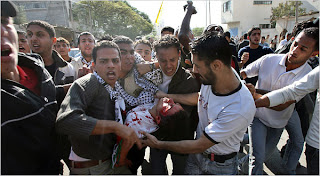
On the 20th day of the conflict, over 1,000 Gazans have been reported killed and many thousands wounded in the Israeli offensive. According to a Palestinian human rights organisation, close to two-thirds are civilians. UNICEF has stated that over 300 children are among those killed in the assault.


An Israeli soldier prays near tanks as his unit prepares to enter the northern Gaza Strip January 14, 2009. Israeli troops edged closer to the heart of Gaza City on Wednesday morning and international organisations expressed growing concern about the plight of children trapped in the offensive.

An injured Palestinian man looks on as others inspect the damage at a building following Israeli military operations, in the Sheikh Radwan neighborhood in Gaza City, Wednesday, Jan.14, 2009. Israeli aircraft pounded militants' rocket-launching pads, weapons arsenals and dozens of arms smuggling tunnels near the Gaza-Egypt border, the military said Wednesday, as UN chief Ban Ki-moon headed to the region to lend his heft to diplomatic efforts to wrest an end to Israel's bruising, 19-day-old assault.

Palestinian medics wheel a wounded girl to the treatment room of Shifa hospital following Israeli military operations in Gaza City, Wednesday, Jan. 14, 2009. Israel showed no signs of slowing its bruising offensive against Gaza's Hamas rulers, striking some 60 targets on Wednesday. Israel launched the onslaught on Dec. 27, seeking to punish the Hamas militant group for years of rocket attacks on southern Israel.

An unidentified relative of Palestinian Hamas member Mohammed al-Kintani mourns during his funeral in Gaza City on January 14, 2009.

Backdropped by Gaza, Israeli soldiers stand on tanks as they prepare for combat missions in Gaza as they gather on the Israel-Gaza border during Israel's military offensive, Wednesday, Jan. 14, 2009. Israeli aircraft struck a Gaza City cemetery Wednesday, pulverizing newly buried bodies, and pounded militants' weapons positions and arms smuggling tunnels, witnesses and the military said.

A Palestinian boy, who fled his home with his family during Israel's offensive, looks at people as they receive food at a UN school in Jabalya in the northern Gaza Strip January 14, 2009.

Medics try to revive Palestinian 3 year-old Aysha Al-Najar, minutes before her death of her wounds during an earlier Israeli military strike, at the Kamal Adwan hospital of the northern Gaza Strip town of Beit Lahiya, Wednesday Jan. 14, 2009.

A group of Israeli Hassidim Jews dance and listen to loud music on top of a vehicle as they celebrate the “success” of Israeli army’s offensive in the Gaza Strip on January 14, 2009 at the Yad Mordechai intersection in southern Israel.

A Palestinian boy carries his belongings as he leaves his house during Israel's offensive in Khuzaa in the southern Gaza Strip January 14, 2009.

Palestinians react during a funeral of four men killed in Israeli military operations, at the mosque in Beit Lahiya northern Gaza Strip, Wednesday, Jan. 14, 2009. Smoke rises following an explosion caused by Israeli military operations is seen through a window of the Associated Press office, riddled by a bullet, in Gaza city, Thursday, Jan. 15, 2009.
A Palestinian girl holds her brother as they pass the al-Noor mosque destroyed after an Israeli air strike in Gaza.
Israeli soldiers take position during a protest held by Palestinians in the West Bank village of Bilin near Ramallah.

Wednesday, January 14, 2009

Bush legacy shaped by war, economic crisis


Bush leaves office with one of the lowest approval ratings of any president in modern times – under 30 percentTWO unfinished wars, the US economy deep in recession, the budget deficit about to hit $1 trillion and America’s image badly tarnished abroad. Not since Herbert Hoover left Franklin Roosevelt the Great Depression has a US president left his successor a litany of problems seemingly as daunting as George W Bush will bequeath to Barack Obama when he takes office on January 20. While Bush and his loyalists insist history will take a kinder view of his legacy, historians are already debating whether he will rank among the worst presidents ever, putting him in the company of Herbert Hoover, Warren Harding and James Buchanan. Some presidential scholars say it’s too soon to render a verdict, but many have made up their minds. “Can anyone really doubt that this was an abysmal presidency?” said Shirley Anne Warshaw, a political scientist at Gettysburg College in Pennsylvania. “All that’s left to sort out now is just how far down the list he goes.” A generation ago, Ronald Reagan, Bush’s Republican hero, asked Americans to think about whether they were better off than when his Democratic opponent, incumbent Jimmy Carter, entered the White House. By that standard, Bush doesn’t stack up well. Ending his eight-year tenure amid the worst financial crisis in 80 years, he leaves with one of the lowest approval ratings of any president in modern times - under 30 percent. The widespread support he won in the aftermath of the September 11 attacks in 2001 is long gone, weighed down by the unpopular war in Iraq, an inept response to Hurricane Katrina and a meltdown on Wall Street that has spilled onto Main Street. At home, unemployment is at a 16-year high, mortgage markets are imploding and people’s savings are slipping away. On the plus side, Bush’s top domestic achievement may be something that didn’t happen - another attack on US soil. “We haven’t had another attack in seven years,” White House spokeswoman Dana Perino said. “And that matters.” Overseas, Bush’s legacy will be defined largely by Iraq, and it will be left to Obama to finalise an exit strategy and repair the damage to US credibility. Bush flew to Baghdad last month hoping to showcase security gains there, but instead the enduring image will be of the president ducking shoes hurled by an angry Iraqi journalist. Bush leaves other unfinished foreign policy business. The nuclear standoff with Iran could be one of Obama’s biggest challenges, testing his promise of direct talks with Tehran to supplant Bush’s policy of diplomatic isolation. In Afghanistan, which critics say Bush neglected because he was too distracted by Iraq, the Taliban are resurgent and Osama bin Laden has yet to be captured or killed. Bush’s effort to broker Israeli-Palestinian peace came, in the view of most analysts, as too little, too late, and the latest crisis in the shape of Israel’s blatant aggression in the Gaza Strip is seen as a fitting epitaph. Obama has promised bolder engagement in the Middle East but will face entrenched distrust in the Arab world of a US bias in favour of Israel, the residue of Bush’s policies. While Obama copes with that, he will inherit another problem from Bush - what to do with terrorism suspects held at Guantanamo Bay. The military detention centre has been a source of human rights condemnation. Obama has vowed to shut it down. Bush also has drawn fire, especially in Europe, for resisting fixed nationwide limits on greenhouse gas emissions to fight climate change, a stance that has added to a perception of US arrogance that Obama must now contend with. On the other hand, Bush has won praise for forging stronger ties with India, nudging China into a more constructive international role and battling the AIDS epidemic in Africa. But it is a once-in-a-century financial crisis - which erupted after six years of presiding over an economy that would be the envy of most presidents - that may have dealt the crowning blow to Bush’s legacy. His administration has resorted to massive government intervention once anathema to his free-market roots. And as ripples have spread worldwide, criticism of unbridled US-style capitalism has grown, raising questions about the future of America’s dominance of the global system. Many analysts say Bush’s deregulatory zeal contributed to the meltdown, though they also agree there is plenty of blame to go around. But since it happened on Bush’s watch, he will likely bear the brunt of history’s judgment. Bush’s Republicans have already heard the voters speak. Obama’s resounding victory in November against John McCain was widely seen as a repudiation of Bush’s policies. “Without Bush, the first African-American president probably wouldn’t have been elected at this time,” said Stephen Wayne, a political scientist at Georgetown University. Mindful of the clock ticking down, Bush has spent his final weeks trying to burnish his legacy. He granted more exit interviews than any recent president, delivered a series of policy speeches and held a farewell news conference. Through it all, Bush has staunchly defended his record but has also seemed more reflective, admitting to reporters on Monday his disappointment that no weapons of mass destruction were found in Iraq and about the Abu Ghraib prisoner abuse scandal that shocked the world. Bush said history would be his judge but only “after some time has passed.” He has insisted he will be vindicated someday like Harry Truman, unpopular when he left office and now admired for his handling of the Cold War. “Truman is the patron saint of failed politicians,” said Douglas Brinkley, a presidential historian at Rice University in Houston. He suggested a likelier comparison to a very different president - Hoover, who presided at the start of the Great Depression.

Israel stops Iranian aid ship for Gaza

Vessel was carrying 200 tonnes of food and medicine.
An Iranian ship carrying aid to Gaza was stopped by Israel’s navy off the coast of the under attack Palestinian territory, Iran’s state radio reported on Tuesday. “An Iranian ship that was carrying foodstuff and medicine was stopped by the Zionist regime’s navy 20 miles off the coast of Gaza,” radio reported, adding that the ship had left the Iranian port of Bandar Abbas 13 days earlier. It said the ship was carrying 200 tonnes of foodstuff and medicine “for distribution among the blockaded people of Gaza.” Iran’s Foreign Ministry said on Monday the ship had passed Port Said, the Egyptian port on the Mediterranean end of the Suez Canal and about 180 kilometres west of the Gaza coast. Ahmad Navvab, described as the ship’s director on board, told Iran’s state radio: “The consignment of relief aid contributed by the people of Iran is now close to Gaza. But the ship has not received any permit to enter Gaza and the Zionist regime is still obstructing it.” Asked if there was any other way for the aid to reach Gaza, Navvab said: “Our effort is to enter Gaza directly, otherwise we will have to do it through Egypt and the Rafah crossing.” Navvab added that officials in Tehran were in contact with Egypt, the only other state apart from Israel with a border to Gaza, to ask them to accept the aid for delivery. Iran said last week it had told Egypt it was ready to treat those wounded in Israel’s assault and wanted to set up a field hospital nearby on Egyptian territory. Iran has also said it had landed a plane in Egypt with aid and wanted to send more. Iran does not have full relations with Egypt, the first Arab country to sign a peace treaty with Israel. Iranian politicians have accused Egypt of not doing enough to help Gaza’s Palestinians.

Tuesday, January 6, 2009

Gaza carnage

The aerial blitz by Israeli defence forces (IDF) which began on December 27 against hapless Palestinians continues unabated. In a week-long savage attack, more than 400 Palestinians, including 113 women and 42 children, have died. Those injured are in the thousands.The world remains a silent spectator to this savagery. Some Western leaders have issued pro forma appeals for a ceasefire to be rejected by Israel with disdain. In pursuance of its vicious policy of ethnic cleansing of Palestinians, Israeli Prime Minister Olmert has maintained that these attacks are "the first of several stages approved by the security cabinet." Israel's brutal policies of genocide have received direct endorsement and encouragement by the US and EU. US President Bush, in a blatant show of uncritical support to Israel, has held Hamas responsible - "Hamas's continued rocket attacks into Israel must cease if the violence is to stop. Hamas must end its terrorist activities if it wishes to play a role in the future of the Palestinian people."

The official EU statement also merely expressed "concern at the events in Gaza." The statement did not carry any condemnation and reference to Israeli brutality to Palestinians. Neither of these statements referred to Israel by name nor condemned the carnage unleashed by IDF and the continued spree of killings and mayhem. The UNSC meeting on December 28 also refrained from blaming Israel for the massacre of Palestinians in its joint statement. Two days later, the Security Council met in a formal session, at the insistence of some members. As expected, the resolution was vetoed by the US and UK. Israel, since its creation, has defied 69 UNSC resolutions and another 30 have been vetoed by the US. Besides the obvious tilt and bias in favour of Tel Aviv, the US media, as also the West, seldom go into the origin of the violence. In the situation under reference, unilateral decree has been issued.The current attacks are interpreted as Israel's right of self-defence. Some rockets fired from Gaza killed one Israeli and provided IDF the justification for its collective punishment and destruction of Palestinian homes.
Gaza is a tiny strip of land, between Egypt and Israel, with 1.5 million inhabitants. Hamas, after its overwhelming victory in the general elections held in early 2006, took over the reigns of government in Gaza. Israel and the US declined to acknowledge Hamas' mandate, dubbing it a terrorist organisation and hence, not a negotiating partner for the settlement of the Palestinian issue. Both also manoeuvred a civil war among the Palestinian factions. Finally, PLO, led by its president, Mahmoud Abbas, lost to Hamas and withdrew from Gaza. Egypt eventually succeeded in brokering a ceasefire between Hamas and the PLO. Later, it also arranged a ceasefire between Hamas and Israel last year, expiring on December 19. Israel withdrew from Gaza in 2005, but has retained complete control of Gaza by sea, air and land. During the ceasefire period, Israel imposed a blockade on Gaza. The Palestinians were not allowed to cross into the West Bank or Egypt through the Rafah exit. The blockade had a debilitating effect on the daily life of Gazans. Essential food supplies, fuel, electricity and water have been periodically denied to the population of 1.5 million, seriously impoverishing their precarious existence. A recent UNWRA report mentions that as a result of Israel's comprehensive economic siege, Palestinians have been forced to scavenge from rubbish dumps. These inhuman policies of economic strangulation have rendered the ceasefire meaningless. Gaza represented a kind of concentration camp, with all restrictions on movements and denial of contact with the outside world. The truce of June 2008 included provisions for ending the embargo. Israel did not observe these terms either. In view of this situation, Hamas decided not to renew the ceasefire on its expiry and decided to retaliate IDF forays in Gaza with firing rockets into Israeli towns, killing one Israeli. This episode was considered grave enough for Israel to retaliate in full measure. Till date, more than 400 Palestinians have been killed in IDF attacks as against 4 Israelis killed by homemade Hamas rockets. The current Israeli offensive began after a visit by Foreign Minister Livni to Cairo on December 25 where she met President Mubarak.
In a press conference in Cairo, Livni vowed to strike at Hamas, declaring that Israel "will not take this situation any longer," creating the impression that the Israeli onslaught has Egyptian approval. Egypt's refusal to open the Rafah border for the Gazans, even for medical reasons, made them bitter and hostile. Mubarak has been accused of complicity with Israel.Israeli attacks against Gaza have led to anger and outrage across the Arab world. The protests and demonstrations in Cairo have been particularly emotionally-charged. Mubarak, during the thirty years of his autocratic rule, has not allowed any opposition to, or criticism of, his policies, domestic or external. According to a State Department Human Rights report, Egypt has more than 10,000 political prisoners and human rights activists languishing in prison for years, without any charge or trial.
It is, therefore, highly significant that Cairo protestors were carrying banners declaring that "Mubarak and Livni have agreed on the genocide of the Palestinian people." The protestors also raised anti-Mubarak slogans - an unprecedented scene. The ongoing massacre and criminal silence of the world and the OIC in the face of such savagery is bound to radicalise the Arab masses. Hamas leader Khalid Mashal has already spoken of the possibility of an Intifada-III. A Saudi cleric, Sheikh Awad Al-Qarni, has issued a fatwa declaring Israelis everywhere a legitimate target for killing. The OIC, as spokesperson of the Muslim world, has remained quiet and moribund, and its Jeddah Declaration of January 3 will only evoke derision, for its banal text. President-elect Obama has maintained studious silence but his "unshakeable commitment to Israel's security" inspires little hope of any significant change in the US position. In the present crisis, Hamas may be facing Israel alone but as the Palestinians have demonstrated, their spirit of resistance shall not break and eventually, will prevail over all odds. Pakistan during Musharraf's reign kept itself aloof from the Palestine problem, and much to the disappointment of Arabs, made contacts with Jewish leaders in America. Foreign Minister Kasuri also met with his Israeli counterpart in Istanbul. Consistent and substantive support to the Palestinian cause has been the cardinal principle of Pakistan's foreign policy. The Zardari government must correct the course and direction of our policy to regain our coveted niche in Arab hearts. Palestinians should not be left alone in this critical moment of their national crisis. In this regard, Zardari must join the initiative by Turkish Prime Minister Erdogan for an immediate ceasefire and end to the blockade of Gaza.

Sunday, January 4, 2009

America & Israel

IT was inconceivable even a few years ago. Let us not forget that the United States is a country where African-Americans were denied basic civil rights well into the 1960s. Yet the US did itself proud last year when diverse liberal forces banded together in a rare show of unity to opt for change and elect Barack Obama as the country’s 44th president. Some touted his election as the rebirth of America, a nation that has historically been open to new ideas and new beginnings. The US is a country that has produced some of the ablest, most brilliant minds in the world. At the same time, however, America has wilfully chosen blindness over sight where Israel is concerned. Any meaningful discussion on Israel is simply not kosher in the United States and the mass media there consistently portrays only one side of the story. Will the election of the young, idealistic Barack Obama change this reality? Going by his statements so far, it is clear that he adheres to the popular perception in the US which is based largely on misinformation. So what we will get, more likely than not, is continued US patronage of a state that sponsors terrorism as a birthright. What will continue to be forgotten is the basic fact that any nation under foreign occupation has a right to resist.

A person need not be sympathetic to the Hamas cause to shed a tear for the Palestinian children killed by Israeli bombardment. It does not require the wisdom of a sage to realise that Hamas is trying to fight an enemy it cannot possibly defeat. What is required is peace. But peace will never break out so long as America keeps turning a blind eye to Israeli barbarity and refuses to assess the situation on the ground in the capacity of an honest broker. For the US, Israel can do no wrong whereas much of the world thinks otherwise. The distinction between the aggressor and the oppressed is clear even in European minds. What one finds in the European media is, relatively speaking, objective analysis. It is sometimes claimed in America that the European soft spot for Palestinians stems from prejudice rooted in the treatment of Jews in Europe. Nothing could be further from the truth. There are racists everywhere, and America is no exception. It’s just that in some parts of the world an ear is lent to both sides of the story. Not so in America.

How Pakistan fared in 2008

Two seminal events, both occurring in 2007, have been responsible for shaping the scheme of things that was to take place in 2008. One, the lawyers' movement for the restoration of the deposed judiciary takes the credit for creating awareness among the public that time had come to stop President Musharraf playing havoc with the rule of law. It must have surprised the general to see the hordes of people issuing forth from every nook and corner of the country, terming his decision to lay off 60-odd superior court judges as entirely unconstitutional and demanding its cancellation. It seemed the whole country had woken up and, frustrated with the unfulfilled rosy promise of a better life by him, was crusading for the return of democracy. The march of events culminated in the promulgation of emergency, but vox populi had registered itself, and there was no other course open to the military-led government but to hold general elections. The retreat of the anti-democratic forces was a moment of exhilaration for the nation.

As it ill luck would have it, a tragic incident, the second seminal event, was waiting to happen. The PPP Chairperson Benazir Bhutto, who was widely expected to head the government after the polls, was mercilessly gunned down, radically changing the political landscape and throwing up certain persons, most prominent being her husband Asif Ali Zardari, in power about whom there was not the wildest thought that they would make it there. Thus, Benazir's death not only garnered sympathy vote for the PPP but also left the people in a strange situation, uneasily guessing whether the new leadership would be able to deliver the goods. The general elections held in February 2008 were by and large free and fair, and the PPP, with its Co-Chairperson Asif Ali Zardari holding the reins of the party, came out commanding the largest number of seats in the National Assembly and the PML (N) of Mian Nawaz Sharif came a close second. Although the PML (N) joined the coalition led by the PPP, their alliance did not last long; the split came almost as soon as their common goal of President Musharraf's ouster had been achieved. Differences over their joint commitments to restore the deposed judiciary and the constitution to its pre-October 1999 position appeared in sharper focus, when the PPP tried to renege on them and the PML (N) refused to compromise, pleading that the implementation of the Charter of Democracy and the Bhurban Declaration was a sine qua non for democracy to flourish. The return of the wrongly ousted judiciary, it rightly maintained, would give the right signal to the public and the rule of law would prevail. The two parties now, however, have an uneasy union at the Punjab level, indulging in blames and controversies and mindless of the damage their wrangling could do to the goal of securing the future of democracy in the country. As it is, the circumstances are indeed trying. Political uncertainties apart, there is the huge phantom of terrorism projecting itself ever deeper into the heartland of the country. To these two disquieting phenomena has been added the economic upheaval that has, in fact, engulfed the entire globe. The prices of oil and food items jacked up astronomically high, before it sharply came down, and created a crisis of dreadful proportion for the importing countries. The impact on the general public has been horrendous. It has upset the housewife's budget out of all reckoning and dragged even the middle classes down the poverty line, thus undoing the years' long effort to given them a taste of happier lives.Nevertheless, the outgoing year witnessed the end of more than eight years of military dictatorship, though the last vestige was to go a few months later, leaving the political leadership face to face with formidable challenges and without the excuse to blame a non-political factor for any wrong that they might commit. Unfortunately, its record so far has been anything but inspiring. The promise of the return to genuine parliamentary system remains a mirage as the 17th amendment and other distortions of the constitution continue to mock at the protagonists of democracy. While the government was found fumbling even as it was dealing with crises of broadly three kinds - political, economic and terrorist - a foreign threat in the form of India's unsubstantiated allegation and its "all-option-open" warning appeared on the horizon. New Delhi-leaning world powers, including the US, readily began trumpeting its cause, ignoring Islamabad's repeated calls that India provided credible evidence. In the global eye that already viewed Pakistan as the fountainhead of militancy, the blame for the Mumbai attacks stuck on elements in its side of the border. Demands issued forth from some capitals of quick and severe action on India's accusations, even though it refused point blank to furnish any evidence. Backed by the US, it acted like a dominant power in the region demanding to have the custody of persons it had named as suspects, and Pakistan's demand for proof of their involvement was dismissed.


For a while, there was eerie fear of hostilities breaking out between the two nuclear neighbours. That fear has subsided but not vanished altogether. Islamabad's redeployment of its armed forces (20,000 out of 100,000 stationed near Pak-Afghan border) to the eastern frontier might give a sobering thought to the US about its fall-out on the war on terror to India about the consequences of a possible extension of Indo-Pakistan war beyond the conventional sphere. The peace loving people in the South Asian subcontinent as well as elsewhere in the world earnestly wish for sanity to prevail in the leaderships guiding the destiny of the two nations, Pakistan and India.

Saturday, December 27, 2008

Bibi's vision of Pakistan

I learnt many things from martyred Mohtarma Benazir Bhutto in my life that made me what I
am today. I became computer literate because of her. I will never forget the day in June 1997 when I was rushed to Rawalpindi's Armed Forces Institute of Cardiology from Adyala Jail in a precarious condition. Bibi (as I addressed in deference and profound affection) sought special permission from the hospital commandant to see me. Besides three books she brought a laptop - my first ever. And handing it over she caringly remarked: "I am appalled by your health condition. Inshalllah you will soon recover and be a freeman as well. You are a Capricorn and I know what they are made of." By the luckiest stroke of fate for me Shaheed Zulfikar Ali Bhutto and I share the same birthday (January 5).Bibi spent nearly two hours in the hospital. We talked about many things including the then political situation. One of her remarks was rather pertinent. "Soon both will dig their own graves and rest in peace." Looking retrospectively events later proved her prophetically correct. One of the three books that she gave me was Thucydides' book on history. "I want you to read it. I hope some day you will write history of Pakistan as you have seen it made." She also wanted me to write a book about great women that I met during my long career as a journalist.

My computer - ever since then - has become most essential part of my life. As far as she was concerned she was not only workaholic but computer addict as well. She virtually organised, ran and monitored PPP through internet. She would get the most classified information from the party workers spread in the nook and corner of Pakistan and who were given access to her email address. She would be informed by her "eyes and ears" who in the party was doing what. Whenever her party people would converge in London, Dubai or elsewhere to meet her - she would just drop a hint or two - to let them know she knew what the butler saw.I don't know if there is any other politician in the world who used computer and internet as much as she did. She would draft hundreds of letters and statements in a week to be passed to her office in Islamabad - to be issued in the name of this or that office-bearer, leader or worker - to sustain pressure on the dictator, to rebut promptly any misleading or incorrect news, to campaign and lobby internationally to mobilise pro-democratic forces to come to the aid of people of the Pakistan struggling for their inalienable right to elect a government of their choice by their vote.Even in very personal emails too she used to reiterate her commitment to revert Pakistan to the vision of Quaid-i-Azam and Quaid-i-Awam, to the empowerment of the people as sole arbiter of power and equal citizens - irrespective of their caste, creed or colour. Her vision of Pakistan was that of a nation-state with maximum provincial autonomy to the federating units.

She was profoundly concerned about the growing religious extremism in Pakistan. And she had pledged her life to save Pakistan from falling in the clutches of Taliban. Had General Pervez Musharraf listened to her advice following the terrorist attack on the Indian Parliament in 2001 in Delhi when she pleaded with him to distance himself from the jihadi groups, Pakistan today would not have been pushed to such a tragic pass and cornered by the Indian coercive diplomacy despite its genuine innocence vis-à-vis Mumbai terrorist attack - as upheld by the Director General of the Interpol who declared that India had neither provided any evidence of Pakistan's complicity in it nor has it given any proof about the sole terrorist held by it of having come from Pakistan. There is lot of weight in the observation of independent analysts that Delhi has been using its recently acquired strategic partnership with Washington for blackmailing Pakistan.Reproduced below is an email from Bibi from Dubai dated January 2, 2006 in response to my New Year greetings. Its relevance today is because of its contents that show how confident she was that return of democracy in Pakistan was around the corner. Alas Pakistan has today a formidable democracy led by President Asif Ali Zardari as the torch bearer of her glorious legacy but when the country needed her most she is not."Dear Wajid Bhai, Thank you for your New Year message. It is amazing how yet another year has passed by. It seems only yesterday that I was filled with happiness because Asif had joined us for the New Year and we took the children out for lunch...Time goes by so fast. But by the Grace of Allah, we have all been able to survive the tests of life. I feel in my bones that now the time is coming where the people will get their democratic rights and we can once again begin the journey that can help us build a constitutional system guaranteeing human dignity and protecting the weak and the endangered. I am thinking of contesting the Senate elections but have not yet made up my mind. The people I talk to within the Party and without are both divided on whether it is a good move. I still have a little time to reflect on it....Meantime our entire top rank of the Party has been wiped out in the Senate elections. I did ask them to lobby for a system where in so far as possible each party lost proportionately the same numbers. However, they felt they had better chances in the general draw and I suppose now live with the consequences....May God bless you and may we enter 2006 on a wave of success that leads to the restoration of constitutionalism, federalism, democracy, provincial autonomy and peoples rights. - Bibi"The writer is serving as Pakistan's High Commissioner to UK.

Tens of thousands gather for Benazir’s memorial

LARKANA: Tens of thousands of Pakistanis massed Friday near the tomb of slain former premier Benazir Bhutto on the eve of ceremonies marking the first anniversary of her killing, officials said.

More than 35,000 people had already arrived in rural southern Pakistan ahead of Saturday's ceremonies at the Bhutto family mausoleum in Garhi Khuda Bakhsh, Pakistan People's Party (PPP) spokesman Ijaz Durrani told AFP.People were travelling by train, bus, car, bicycle and even on foot to reach the site, he said. Hundreds of thousands were expected by Saturday.Bhutto, 54, was assassinated on December 27, 2007 in a gun and suicide attack at an election rally in the garrison city of Rawalpindi, just two months after returning to Pakistan from exile.Her killing threw the country into chaos, sparking violence and leading to months of political turmoil that ended in September when her widower Asif Ali Zardari claimed the presidency.Zardari and their son Bilawal Bhutto Zardari, who co-chairs the PPP with his father, were expected to lead the procession of mourners on Saturday amid tight security.Saturday's commemoration ceremony is due to begin at 09:00 a.m. with a reading from the Holy Quran. Zardari and Prime Minister Yousuf Raza Gilani are expected to address the crowd.About 8,000 police, paramilitary rangers, party workers and volunteers have fanned out around the tomb to protect Zardari, his son and two daughters, Gilani and other dignitaries expected to attend, the PPP spokesman said.Events in Bhutto's honour will also be held in cities nationwide.


In Garhi Khuda Bakhsh, visitors carried portraits of Benazir Bhutto, and vendors were doing a brisk business in Benazir Bhutto memorabilia, selling posters and CD recordings of her speeches, witnesses told AFP.
Zardari has ordered local officials to arrange for meals for the mourners, Durrani said.
Hundreds of tents have been set up to accommodate those who needed to sleep Friday night near the gravesite, a local police official told AFP.


The government has declared Saturday a national holiday in honour of the charismatic, Oxford-educated Bhutto, the first woman to lead a Muslim nation.
One year on, Pakistan's reverence for the two-time former premier continues unabated — television programmes about her life have been running for days, and the government has issued a 10-rupee coin and stamps bearing her portrait.
The home minister of southern Sindh province, Zulfiqar Mirza, has warned of the possibility of violence linked to the Bhutto commemorations, but provincial spokesman Waqar Mehdi said authorities had taken appropriate steps.
'We realise the gravity of the situation and thus we are taking all possible foolproof measures to avoid terrorism at the anniversary of the death of our leader, who herself was also a victim of such a savage act,' Mehdi said.
A special security wall has been erected around the mausoleum as part of a raft of precautions taken to safeguard Zardari. Closed-circuit cameras have been installed, and mourners will have to pass through metal detectors.